Philosophers / Stoicism

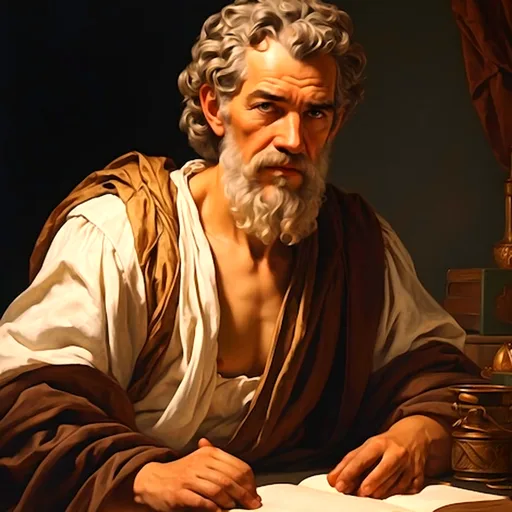
Cato the Younger
Italy -0094-01-0 ~ -0045-01-0
Roman senator (95-46 BC) and the most uncompromising Stoic of the late Republic, remembered as the man who could not be bribed. He chose suicide at Utica over surrender to Julius Caesar, and his refusal to bend became a moral touchstone for Seneca, the American Founders, and the modern Stoicism revival.
What You Can Learn
Cato's life poses an uncomfortable question to anyone working inside an institution: where exactly is the line you will not cross, and what would it cost you to defend it? Most careers are built on a thousand small accommodations — laughing at the boss's joke, signing off on the borderline expense report, staying silent in the meeting that mattered. Cato's claim is that those small concessions compound, and one day you wake up holding nothing of your own. His treasury reform reads like a textbook for modern compliance officers and auditors: open the books, prosecute fraud regardless of rank, accept that you will be hated. But his rigidity also failed to save the Republic, and that is the harder lesson — knowing which battles deserve your absolute self and which require pragmatic compromise. In an age of viral outrage and 24-hour reputational cycles, betting on decade-long integrity instead of quarterly applause is a Cato-style wager: lonely, costly, and disproportionately rewarded over time. The Stoic Challenge movement, voluntary discomfort practices, and minimalism all trace their ancestry to his deliberate austerity.
Words That Resonate
Behold a spectacle worthy of God's attention as he contemplates his work; behold a contest worthy of God: a brave man matched against ill fortune.
Ecce spectaculum dignum ad quod respiciat intentus operi suo deus, ecce par deo dignum, vir fortis cum fortuna mala compositus.
Follow the god.
Sequere deum.
Cato, while he lived, lived in such a way that he lacked nothing — so long as he was free to die.
Cato, dum vixit, sic vixit ut nihil ei deesset, dum mori liceret.
The victorious cause pleased the gods, but the conquered cause pleased Cato.
Victrix causa diis placuit, sed victa Catoni.
Life & Legacy
Marcus Porcius Cato Uticensis stands as one of the most uncompromising figures in Roman political history. Known as Cato the Younger to distinguish him from his great-grandfather Cato the Censor, he transformed Stoic philosophy from an academic exercise into a way of dying.
Orphaned young, Cato was raised in the household of his uncle Marcus Livius Drusus. The boy who would later defy emperors first showed his temper as a child: when an Italian leader threatened to throw him from a window unless he persuaded his uncle to grant Italian citizenship, Cato refused without flinching. As an adult he received his inheritance, moved out, and devoted himself to Stoic studies and a life of conspicuous austerity. He went without a tunic in winter, traveled on foot among riders, and ate the same coarse food as common soldiers. These were not eccentricities but disciplined exercises designed to make him invulnerable to the threats and bribes that controlled most Roman politicians.
In 63 BC, as urban quaestor, he overhauled the treasury with relentless honesty, prosecuting predecessors for embezzlement and forcing the receipts of half a century back into the open. As tribune in 62 BC he expanded the grain dole to the urban poor and pushed laws compelling generals to disband their armies before standing for election — a direct strike at Pompey and the rising Caesar. When the First Triumvirate formed, Cato became the institutional opposition by himself, filibustering the Senate for entire days to block their bills. The English word filibuster has its political ancestry partly in his obstruction.
The core of Cato's philosophy was the Stoic refusal to surrender his judgment to anything outside his control — not wealth, not threats, not the affections of crowds. When Caesar won the civil war and the Republic was finished, Cato withdrew to Utica in North Africa, organized the safe departure of his troops and friends, then read Plato's Phaedo twice through and stabbed himself. Revived by his physician, who sewed up the wound, he tore it open again with his own hands. Caesar, on receiving the news, is said to have lamented: "Cato, I begrudge you your death, as you begrudged me the chance to spare your life."
His afterlife eclipsed his life. Seneca quoted him as the model sage; Lucan made him the moral hero of the Pharsalia; Joseph Addison's 1713 play Cato became required reading for the American revolutionaries. George Washington had it performed for his troops at Valley Forge, and Patrick Henry's "Give me liberty, or give me death" echoes its rhetoric. The modern Stoic revival, from Tim Ferriss to Ryan Holiday, returns repeatedly to the man who proved a philosophy by dying for it.
Expert Perspective
Within the Stoic tradition, Cato is unique as a practitioner rather than a theorist. While Zeno and Chrysippus systematized the doctrine and Seneca, Epictetus, and Marcus Aurelius preserved it in writing, Cato proved it with his life. His role in Stoicism resembles Socrates's role in early Greek philosophy — the man whose death validated everything the school taught about virtue being the only good. The modern Stoicism revival, despite its book-driven public face, returns again and again to Cato because he supplies the existential proof that Seneca's prose alone cannot.