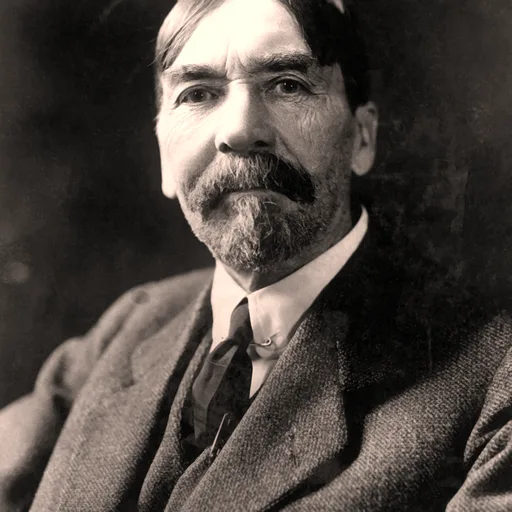
Economists / neoclassical

Vilfredo Pareto
Italy 1848-07-15 ~ 1923-08-19
Born 1848 in Paris to exiled Italian nobility. Engineer turned economist, succeeded Walras at Lausanne aged forty-eight. Formulated Pareto optimality and the 80/20 rule. Major contributor to both economics and sociology.
What You Can Learn
The 80/20 rule is among the most applied economic insights today. Twenty percent of customers generate eighty percent of revenue; a few portfolio holdings drive most returns; twenty percent of code contains most bugs. Pareto optimality remains the basic tool for policy analysis, clarifying trade-offs without interpersonal utility comparisons. In ESG and stakeholder capitalism debates it frames efficiency-equity balance. Power-law distributions illuminate winner-take-all platform dynamics in digital economies.
Words That Resonate
Life & Legacy
Vilfredo Pareto brought engineering rigor to economics and sociology. As Walras's successor at Lausanne, he refined general equilibrium theory while discovering empirical regularities in income distribution.
Born 1848 in Paris, son of Marquis Raffaele Pareto, a Genoese nobleman exiled for supporting Mazzini. The family returned to Italy in 1858. He studied at Turin Polytechnic, graduating 1869 with a thesis on elastic solid equilibrium. He then spent twenty years managing railway and iron companies.
This industrial experience grounded his economics in empirical observation. From the late 1880s he attacked Italian protectionist tariffs. Reading Walras proved transformative; in 1893 Walras recommended him as successor at Lausanne.
There he systematized indifference curves and introduced ordinal utility, eliminating cardinal measurement. This became modern consumer theory's foundation. Pareto optimality, where no one improves without another worsening, gave welfare economics its basic criterion without interpersonal utility comparisons.
His income distribution studies revealed stable inequality across countries: a small fraction holds most wealth. This Pareto distribution generalized into the 80/20 rule.
From 1907 he turned to sociology. His 1916 Treatise on General Sociology proposed elite circulation: societies are governed by elites whose quality degrades until replaced. This influenced political sociology.
He died 1923 at Celigny, aged seventy-five. His economic contributions are universally foundational, while his elite theory's use by Mussolini complicates his sociological legacy.
Expert Perspective
Pareto inherited Walras's general equilibrium, introducing ordinal utility and indifference curves that eliminated cardinal assumptions. Pareto optimality became welfare economics' core criterion. His discovery of stable income inequality patterns launched statistical wealth distribution analysis.