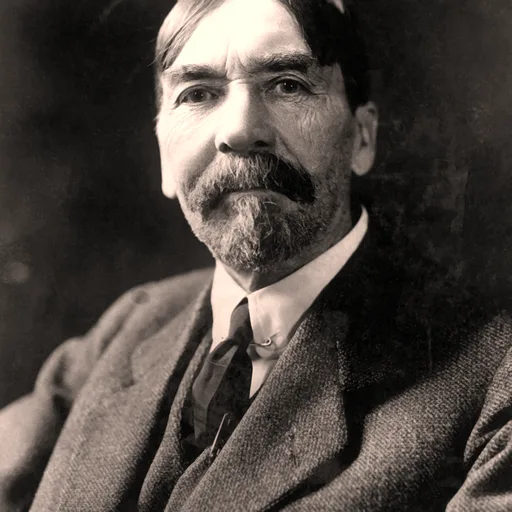
Economists / utopian

Robert Owen
United Kingdom 1771-05-14 ~ 1858-11-17
Born in 1771 in Wales, Robert Owen was a textile manufacturer, philanthropist, and social reformer who became a founder of utopian socialism and the cooperative movement. At his New Lanark mills in Scotland, he proved that investing in workers' welfare (reduced hours, education, housing) could increase rather than reduce profits. His experimental community at New Harmony, Indiana failed after two years, but his ideas on labor reform, free education, and cooperative enterprise shaped the British labor movement and modern human capital theory.
What You Can Learn
Owen's New Lanark experiment is a 200-year-old proof of concept for modern ESG investing and stakeholder capitalism. His central finding, that investing in worker welfare (education, health, reduced hours, decent housing) increases rather than decreases profitability, is confirmed by contemporary research on human capital returns. His failure at New Harmony is equally instructive: it demonstrates that idealism without incentive alignment, governance structures, and participant selection creates unsustainable communities. For modern founders and organizational designers, Owen's dual legacy encodes a critical lesson: vision alone is insufficient; it must be married to incentive structures that align individual motivation with collective goals. The cooperative model he pioneered, now a $3 trillion global sector, remains his most durable institutional innovation.
Words That Resonate
All the world is queer save thee and me, and even thou art a little queer.
Any general character, from the best to the worst, from the most ignorant to the most enlightened, may be given to any community, even to the world at large, by the application of proper means.
Is it not the interest of the human race that every one should be so taught and placed, that he would find his highest enjoyment to arise from the continued practice of doing all in his power to promote the well-being of every man, woman, and child?
Life & Legacy
Robert Owen was the first person to attempt to transform capitalism from within. As a factory owner who accumulated great wealth, he systematically invested that wealth in workers' welfare and social experimentation, demonstrating that profit and humanity were not opposing forces. His practice at New Lanark anticipated modern stakeholder capitalism by two centuries.
Born in Newtown, Wales, the son of a saddler, Owen left school at ten to become a draper's apprentice. By eighteen he was in Manchester's textile industry, displaying extraordinary entrepreneurial ability. In 1799, at age twenty-eight, he purchased the New Lanark cotton mills in Scotland, one of Britain's largest industrial operations with some 2,000 workers, 500 of them children brought from poorhouses at age five or six.
Owen's reforms at New Lanark were revolutionary for their time. He raised the minimum working age to ten, reduced hours, established the first workplace nursery school, created a cooperative store selling goods at near-cost, and founded the 'Institute for the Formation of Character,' emphasizing moral education over mere vocational training. Crucially, these reforms did not reduce profits. Workers' improved health, education, and morale increased productivity, and New Lanark became one of Britain's most profitable factories while also becoming a pilgrimage site for reformers, statesmen, and intellectuals from across Europe.
Emboldened by this success, Owen attempted to scale his vision. In 1824, he invested most of his fortune in New Harmony, Indiana, an experimental community designed to demonstrate that cooperative living could replace competitive individualism. The experiment collapsed within two years. Without selective admission, without private property incentives, and without clear governance structures, the community devolved into faction and failure. Owen lost most of his wealth.
Undeterred, he returned to London and spent his remaining decades championing working-class causes. He led development of the cooperative movement and trade unionism, supported child labor legislation, and advocated free coeducational schools. He died in 1858 at age 87. His ideas were carried forward by the Fabian Society, the Labour Party, and the global cooperative movement that today comprises over one billion members worldwide.
Expert Perspective
Among economists and social reformers, Owen is the 'experimenting capitalist' who challenged the system from within rather than from outside. While Marx analyzed and criticized capitalism theoretically, Owen actually ran a factory and proved alternatives were possible. The label 'utopian socialist' applied by later Marxists was intended as dismissive, yet Owen was arguably more 'scientific' than Marx in that he conducted actual experiments and gathered empirical evidence. He represents a lineage of reform through practice rather than theory, making him a precursor not of revolutionary socialism but of social enterprise and impact investing.