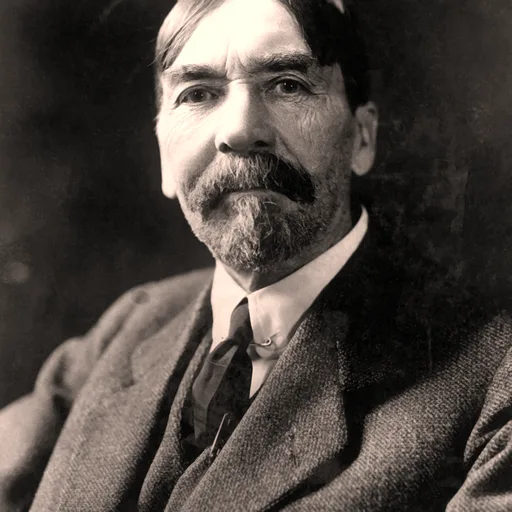
Economists / georgist

Henry George
United States 1839-09-02 ~ 1897-10-29
Born in 1839 in Philadelphia, Henry George was a political economist, journalist, and social philosopher whose book 'Progress and Poverty' (1879) sold millions of copies and became perhaps the most widely read economics text of the nineteenth century. He argued that land rent, the unearned income captured by landowners from socially created value, was the fundamental cause of poverty amid progress, and proposed a 'single tax' on land values as the remedy. His ideas inspired Georgism, influenced figures from Tolstoy to Sun Yat-sen to Einstein, and continue to shape land value taxation policy worldwide.
What You Can Learn
George's thought possesses remarkable contemporary relevance in the age of technology-driven inequality. First, his core question, 'why does technological progress not produce universal prosperity,' applies directly to the AI era. The benefits of innovation tend to concentrate among holders of intellectual property and platform monopolies (the modern equivalent of land rent). Second, his land value tax concept is actively debated in cities where technology industry concentration drives housing unaffordability (San Francisco, London, Singapore). Third, George's concept of 'unearned increment' maps precisely onto platform companies' rent-seeking: much of GAFAM's profit derives from network effects and data monopolies that represent socially created value privately captured, exactly the structure George identified in land ownership. His single tax proposal, by targeting unearned rents rather than productive activity, remains one of the most elegant solutions to the problem of taxing wealth without discouraging work.
Words That Resonate
Man is the only animal whose desires increase as they are fed; the only animal that is never satisfied.
There is danger in reckless change; but greater danger in blind conservatism.
The march of invention has clothed mankind with powers of which a century ago the boldest imagination could not have dreamt. But in factories where labor-saving machinery has reached its most wonderful development, little children are at work.
Life & Legacy
Henry George was the most widely read economic thinker of nineteenth-century America, and his central question, why does poverty deepen as economies grow, remains as urgent in the age of artificial intelligence as it was in the age of railroads.
Born in Philadelphia as the second of ten children to a religious publisher, George left formal education at fourteen and went to sea at fifteen. Landing in San Francisco, he worked as a typesetter, fell in love with Annie Fox from Australia, eloped with her, and experienced extreme poverty firsthand: after the birth of his second child, with no money for food, he approached a stranger on the street prepared to rob him if necessary. The man gave him five dollars.
George built a career in journalism, eventually becoming managing editor of the San Francisco Times. His editorial 'What the Railroads Will Bring Us' (1868) became required reading in California schools for decades. But his intellectual breakthrough came from observing California's paradox: rapid economic development was making land speculators rich while impoverishing workers who actually produced value.
In 1879, he self-published 'Progress and Poverty,' which was commercially released the following year and became an international sensation. The book's argument was elegant: land is not created by human effort, yet its value increases with social development. Landowners capture this socially created value as rent without contributing anything. This monopoly on nature's gifts is the fundamental cause of poverty amid progress. The solution: a single tax on land values, replacing all taxes on labor and capital, which would simultaneously promote economic efficiency and social justice.
George's popularity was extraordinary. He ran for New York City mayor in 1886 as the United Labor Party candidate, finishing second and ahead of Republican Theodore Roosevelt. He died during his second mayoral campaign in 1897 at age 58, just four days before the election. An estimated 100,000 people viewed his body at Grand Central Palace.
George's influence radiated globally. Tolstoy called him 'one of the greatest of all reformers.' Sun Yat-sen incorporated Georgist principles into his economic program for China. Winston Churchill championed land value taxation in Parliament. Australia, New Zealand, Denmark, and Taiwan implemented partial land value taxes inspired by his work. In modern economics, Joseph Stiglitz's 'Henry George Theorem' formally demonstrates that under certain conditions, aggregate land rent equals optimal public expenditure, vindicating George's intuition with mathematical rigor.
Expert Perspective
Among economists, George created the unique category of 'citizen economist': holding no academic position, possessing no doctorate, starting as a journalist, and reaching millions through bestselling prose rather than mathematical models. Where academic economists speak in equations, George wrote in language every citizen could understand. This 'democratized economics' approach was simultaneously a precursor to modern populist economic discourse and a demonstration that economic debates too important for society can be liberated from expert circles. His outsider status explains both his massive popular influence and his marginalization within professional economics.