Investors / Value Investing
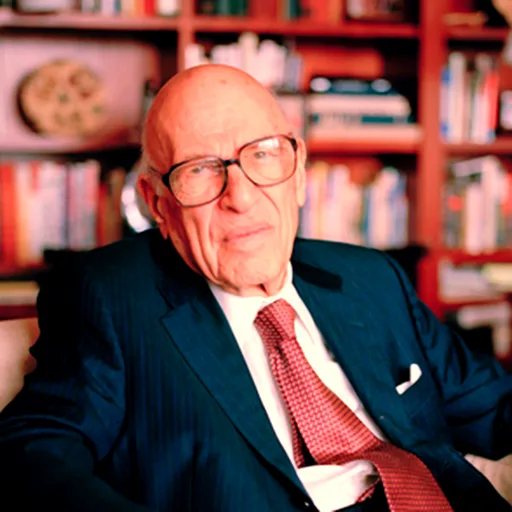
Walter Schloss
United States 1916-08-28 ~ 2012-02-19
20th-century American deep-value investor
Never attended college, learned from Graham, and compounded at ~16% for half a century
Publicly available data is all you need to beat the market — an encouraging fact for every individual investor
Born in 1916 in New York, died in 2012. Walter Schloss never attended college but learned investing under Benjamin Graham and went on to compound at roughly 16% annually for nearly half a century from a spartan office. Buffett named him a 'superinvestor'; he was the last orthodox heir of Graham-style deep-value investing, embodying diversification, patience, and frugality.
What You Can Learn
Schloss's method delivers an important insight in an era when AI-powered stock analysis is on the rise. First, the fact that he beat the market without any technological advantage is encouraging to anyone who feels disadvantaged by the tech gap: publicly available filings and data are sufficient for sound stock analysis. Second, his extreme diversification — roughly 100 holdings at all times — is a natural fit for investors who enjoy researching individual stocks but fear the catastrophic loss of a concentrated portfolio. It occupies a middle ground between index investing and concentrated bets. Third, his numbers-only style, free of management meetings or industry gossip, demonstrates that individual investors can achieve outperformance using tools available to everyone. Schloss's career is democratic proof that discipline and patience, not special talent, are the prerequisites for building wealth through investing.
Words That Resonate
Life & Legacy
Walter Schloss produced outstanding investment results for nearly half a century from a setting that could hardly have been further from the glamour of Wall Street. He never visited companies, never met management, never used a computer. Armed only with balance sheets and stock prices, he selected his holdings — a method whose very austerity carries a paradoxically powerful lesson for today's information-saturated investors.
Born in August 1916 in New York, Schloss was denied a college education by the Great Depression. At 18 he found work as a runner — a document courier — at a Wall Street brokerage. There, a stroke of fortune changed his trajectory: in the late 1930s he attended an investment course that Benjamin Graham taught at the New York Institute of Finance. The asset-based investing philosophy Graham set out in Security Analysis gave Schloss, who lacked formal higher education, a rigorous intellectual framework for confronting the market. Deeply impressed, he served in World War II, then joined Graham's firm, Graham-Newman, after the war. There he sat alongside the young Warren Buffett.
When Graham-Newman dissolved in 1955, Schloss set up his own investment partnership. The operation was austere in the extreme. He and his son Edwin occupied a small Manhattan office; there was no secretary, no analyst-report subscription. His research materials consisted chiefly of Value Line data sheets and SEC filings. He faithfully adhered to Graham's orthodox method: patiently accumulating stocks trading below book value.
The results were remarkable. From 1955 to 2002 — roughly 47 years — his partnership delivered an annualized return of about 16% after fees, handily beating the S&P 500's approximately 11% over the same period. What makes the performance especially striking is that he achieved it through extreme diversification: his portfolio typically held about 100 names, and he never allowed a single position to grow large enough to threaten the whole. This was the polar opposite of Buffett's concentrated approach. Schloss deliberately maintained a structure in which no single misjudgment could cause portfolio-wide damage.
Schloss's name reached a wider audience through Buffett's 1984 lecture at Columbia University, 'The Superinvestors of Graham-and-Doddsville.' Buffett presented him as exhibit A against the efficient-market hypothesis: a man with no degree, no connections, no computer who had quietly built wealth by following Graham's principles. The image became a symbol of equal opportunity in investing.
Schloss's philosophy can be stated in remarkably few words. First, buy at a large discount to book value. Second, check whether management owns stock. Third, wait patiently for value to surface. Fourth, fear loss. He lived by the belief that 'not losing money comes first; profits follow.' He closed his partnership in 2003 but continued to follow markets. He devoted his later years partly to philanthropy and died of leukemia in February 2012 at 95. What Schloss left behind is proof that discipline and patience alone — without complex financial engineering or algorithms — can be enough to beat the market.
Expert Perspective
Among investor archetypes, Schloss is the purest practitioner of Graham-style deep value. Where Buffett evolved toward 'wonderful businesses at fair prices,' Schloss spent his entire career buying 'mediocre businesses below book value' — staying faithful to the Graham prototype. His extreme diversification across roughly a thousand names over his career stands in stark contrast to the concentration favored by Buffett and Munger. His dependence on technology was essentially nil; he operated his fund with none of the hedge-fund industry's gloss for half a century. His risk posture was deeply conservative, with capital preservation as the overriding priority — a defensive value-investing archetype.