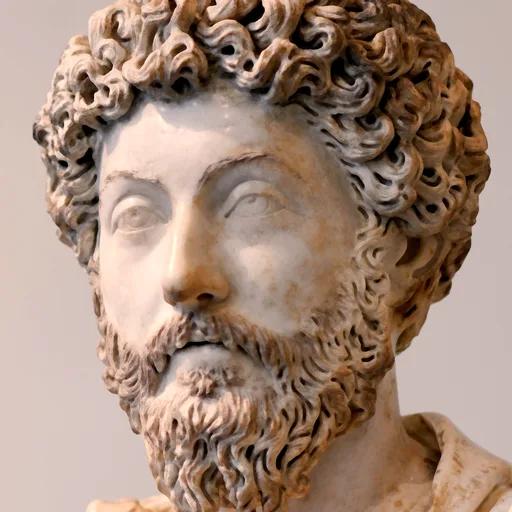
Politicians / ancient_roman

Antoninus Pius
Italy 0086-09-17 ~ 0161-03-06
15th Roman emperor (86-161), fourth of the Nerva-Antonine dynasty and third of the Five Good Emperors. Adopted by Hadrian and elevated in 138, he ruled for 23 years without leaving Italy, presiding over the most peaceful stretch of the Principate. He earned the title Pius for securing Hadrian's deification and for codifying important principles of Roman law including the presumption of innocence. His reign also drew later criticism for failing to wage preventive wars on the eastern and German frontiers.
What You Can Learn
Antoninus Pius embodies the power of the still leader. Twenty-three years without leaving the capital, ruling by letter and trusted lieutenants, anticipates the modern distributed CEO who relies on delegation, written culture and clear principles rather than constant on-site intervention. His rapid tax suspensions and rebuilding grants for disaster-hit cities sit comfortably in today's ESG and stakeholder-capitalism debate as an early model of corporate citizenship. But the critique that he 'priced peace too high' is also instructive. Leaders who avoid all preventive investment in R&D or succession risk handing successors a manageable present and an unmanageable future. His dying word, aequanimitas, distills Stoic practice into a single noun and pairs naturally with Marcus Aurelius's Meditations as a manual for the leader who must remain composed amid market volatility and internal politics. The 2.7 billion-sesterce surplus he bequeathed is a parable of long-horizon financial discipline.
Words That Resonate
The deified Antoninus Pius.
Divus Antoninus Pius.
A cumin-splitter (i.e. extreme penny-pincher).
Cuminum sectorem.
We have gained an empire and lost even what we had before.
Imperium adquisivimus et quae prius habebamus amisimus.
Equanimity.
Aequanimitas.
It is more honourable for the commonwealth to save one citizen than to kill a thousand enemies.
Honestius est rei publicae causa unum civem servare quam mille hostes occidere.
Life & Legacy
Titus Aelius Hadrianus Antoninus was born on 19 September AD 86 near Lanuvium, Italy, into a relatively new senatorial family from Nemausus (modern Nimes) in Narbonese Gaul. Orphaned early, he was raised by his maternal grandfather Gnaeus Arrius Antoninus, a cultured senator and friend of Pliny the Younger. Between 110 and 115 he married Annia Galeria Faustina the Elder, by all accounts a happy union, and they had four children, of whom only Faustina the Younger survived to adulthood. After Faustina's death in 141 he refused to remarry, living with her freedwoman Galeria Lysistrate.
After holding the standard quaestorship, praetorship and the consulship of 120, he was appointed by Hadrian as one of four proconsular administrators of Italy and then as proconsul of Asia (c. 134-135), where his light hand and judicial care made his reputation. When Hadrian's first chosen heir Lucius Aelius died unexpectedly, the emperor adopted Antoninus on 25 February 138 on the condition that Antoninus in turn adopt the young Marcus Annius Verus (the future Marcus Aurelius) and Lucius Verus. Hadrian died on 10 July 138 and Antoninus succeeded smoothly.
His first task was to persuade a reluctant Senate to deify the unpopular Hadrian. His success earned him the title Pius, also justified by the tradition that he had earlier saved senators whom Hadrian had marked for execution. He left Hadrian's administrative structures largely intact and surrounded himself with a tight inner circle of senatorial families.
The defining peculiarity of his 23-year reign was that he never left Italy. The Journal of Roman Studies records that he probably never saw or commanded a Roman army, and never came within five hundred miles of a legion. He delegated provincial affairs to his governors and corresponded with cities by imperial letter. Limited operations did occur. In Britain his governor Quintus Lollius Urbicus invaded southern Scotland from 139 and built the Antonine Wall, roughly 60 km of turf and stone from the Firth of Forth to the Firth of Clyde. Supply lines proved expensive and the land barren, so the wall was decommissioned in the 150s and abandoned in the early 160s. Smaller troubles flared in Mauretania, Dacia Inferior, Judaea and among the Brigantes, but all were contained by provincial commanders.
His great civil work was legal. Five jurists led by Lucius Volusius Maecianus advised him and shaped principles that flowed into Gaius's Institutes. Antoninus introduced the presumption of innocence (suspects not to be treated as condemned), the rule that crimes should be tried where they were committed, and forbade torture of citizens under fourteen with limited exceptions. He extended favor libertatis to make manumission easier, banned masters from killing slaves without trial, and authorized provincial governors to force the sale of slaves who were chronically mistreated.
In economic policy he suspended taxes for cities hit by disaster, lavishly funded the rebuilding of Rhodes and the Asian cities damaged by earthquakes in c. 140 and 152, and was praised for it by Aelius Aristides and Pausanias. The 900th anniversary games of Rome in 148 displayed elephants, giraffes, rhinoceroses, crocodiles and hippopotami, but the cost forced him to debase the silver denarius from 89 percent to 83.5 percent. Despite this he left a treasury surplus of about 2.7 billion sesterces, a fiscal high-water mark for the Principate.
He died on 7 March 161 at Lorium, his ancestral estate in Etruria, after a brief fever. The biographer reports that his last word, given as the night-watch password, was aequanimitas. Marcus Aurelius and Lucius Verus succeeded him as co-emperors, the first such joint succession in Roman history. Later judgment of his reign is mixed. Gibbon and the eleventh edition of Britannica idealized him as the model of dutiful peace. J. B. Bury and Ernst Kornemann complained that he paid for peace too dearly and missed the chance for preventive wars against the Parthians and Germanic tribes, calamities that hit Marcus's reign in the form of the Antonine plague and the Marcomannic wars. Still, the Antonine Wall, the surplus and the legal code are durable monuments to a reign of administrative virtue.
Expert Perspective
Within the political tradition Antoninus Pius is the rare ruler who joined the Five Good Emperors through governance quality rather than conquest. Twenty-three years without leaving Italy and a 2.7 billion-sesterce surplus mark a fiscal peak of the Principate, while the legal innovations of presumption of innocence and structured slave protection passed through Gaius's Institutes into the bones of Roman law. Yet the failure to wage preventive war against Parthia and the Marcomanni primed the disasters of Marcus's reign, a tension that continues to divide historians.