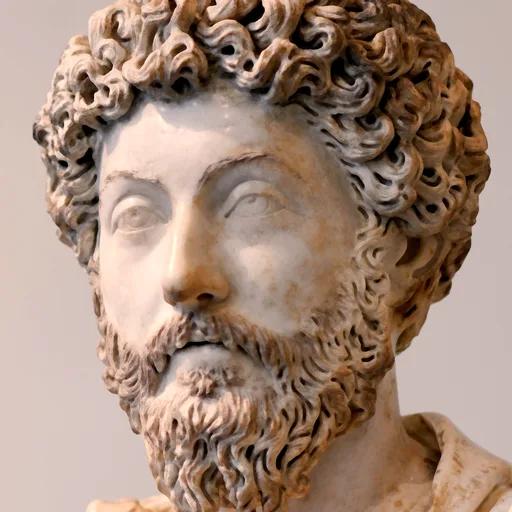
Philosophers / Ancient Greek

Diogenes of Sinope
TR -0399-01-01 ~ -0322-01-01
5th-century BCE Cynic philosopher of ancient Greece
Lived in a storage jar and practiced the philosophy of self-sufficiency by rejecting social convention
'What do I truly need?' is a question at the very root of the FIRE movement
Born around 412 BCE in the Black Sea port of Sinope, Diogenes was the quintessential Cynic philosopher of ancient Greece. He chose a large storage jar as his dwelling, rejected wealth, fame, and social convention, and lived a life of radical self-sufficiency. His anecdotes — carrying a lamp in daylight 'searching for a human being,' telling Alexander the Great to stop blocking his sunlight — symbolize the pursuit of an unadorned existence. His thoroughgoing philosophy of autarkeia (self-sufficiency) became a wellspring of Stoicism.
What You Can Learn
Diogenes's philosophy of 'stripping needs down to the essential minimum' is fundamentally aligned with today's minimalism and FIRE (Financial Independence, Retire Early) movements. As long as happiness is measured by the quantity of possessions, people remain trapped in an endless cycle of earning and consuming. Diogenes's contentment with a single storage jar was no eccentricity; it was the result of ruthlessly asking 'what do I truly need?' This question translates directly into modern discussions about optimizing spending for wealth accumulation and choosing careers that value free time and psychological fulfillment over salary alone. His practice of parrhesia (fearless speech) also resonates with the challenge of speaking truth to power within organizations. In a modern organizational context that prizes psychological safety, constructive candor is one of the rarest and most valuable capabilities. The question 'I am searching for a human being' can serve as a guide for self-examination in the social-media age — a habit of checking whether one's words and actions are genuinely aligned, rather than judging by titles or follower counts.
Words That Resonate
I am a citizen of the world.
Kosmopolites eimi.
If I were not Alexander, I would wish to be Diogenes.
Ei me Alexandros emen, Diogenes an emen.
Stand a little out of my sunlight.
Anachoreison mikron apo tou heliou.
Other dogs bite their enemies; I bite my friends — to save them.
Tous men allous kynas tous echthrous daknein, ego de tous philous, hopos autous soso.
I am searching for a human being.
Anthropon zeto.
Life & Legacy
Diogenes was the thinker who judged most of society's accepted values to be fictions and, through the practice of living with nothing but his own body, turned philosophy itself into an act. He communicated his thought not through written treatises but through street-level conduct and cutting wit — a stance profoundly alien within ancient Greek philosophy, one that simultaneously shocked and unsettled his contemporaries.
Born in Sinope, a trading city on the southern shore of the Black Sea, to a banker father, Diogenes was reportedly exiled after his father Hicesias was implicated in a currency-debasement scandal. This experience of 'debasing the coinage' became the template for his thought. Having witnessed firsthand how easily money — that product of social consensus — could crumble, he eventually came to regard all social norms as 'currency' whose face value deserved to be questioned. After moving to Athens he studied under Antisthenes, inheriting the Socratic tradition of dialogical reason while developing his own methodology of demonstrating truth through action rather than words.
The core of Diogenes's philosophy is the principle 'follow nature, defy convention.' For him the institutions and etiquette of civilized society were shackles that distorted human nature. Abandoning private property, making a large jar (pithos) in the marketplace his home, and subsisting on the bare minimum of food and clothing were not asceticism for its own sake but a philosophical experiment proving through lived experience how little a human being actually needs. The anecdote of discarding even his single bowl after watching a child drink water with cupped hands shows how far his pursuit of autarkeia (self-sufficiency) was carried. He did not shrink from calling himself a 'dog' — living without pretense, loyal to one's nature, barking at falsehood. The name 'Cynic' itself is said to derive from the Greek word for dog (kyon), and Diogenes's way of life became the school's manifesto.
The scene that most concentrates his thought is the encounter with Alexander the Great. Alexander, the conqueror of the world, visited Diogenes as he sunbathed in Corinth and asked, 'Is there anything you wish for?' 'Stand a little out of my sunlight,' came the reply. This was more than defiance of power. Even the mightiest authority on earth cannot bestow sunlight, yet the philosopher who owns nothing is already enjoying it — a radical interrogation of the relationship between possession and happiness. The tradition that Alexander said 'If I were not Alexander, I would wish to be Diogenes' attests to the force of freedom that even the summit of power had to acknowledge.
Another famous episode has Diogenes walking through the Athenian marketplace in broad daylight carrying a lit lamp, declaring 'I am searching for a human being.' This was not mere satire about the scarcity of honest people; it was a philosophical question about how many, stripped of social rank and title, are living in a way that truly deserves the name 'human.' Diogenes is also known as one of the earliest figures to call himself a 'citizen of the world' (kosmopolites). Against the Greek convention of locating human worth in polis citizenship, he proposed grounding identity in a universal reason that transcends borders and origin.
No direct writings by Diogenes survive, but through his pupil Crates his spirit passed to Zeno of Citium, founder of Stoicism. Many of Stoicism's core concepts — harmony with nature, detachment from externals, cosmopolitanism — carry within them a moderated version of Diogenes's radical practice. He is said to have died in Corinth around 323 BCE — tradition has it on the same day as Alexander the Great. A dog was reportedly carved on his tombstone, a final consistency with the identity of 'the dog philosopher' that he maintained even in death.
Expert Perspective
Within the history of Western philosophy, Diogenes stands at the extreme of practical ethics — a thinker who made his way of life itself his philosophy rather than constructing a systematic theory. Where Socrates pursued rational inquiry through dialogue and Plato systematized metaphysics with his Theory of Forms, Diogenes rejected verbal argumentation and expressed thought through action and body — pioneering a 'performative philosophy.' His radical naturalism sharpened Antisthenes's interpretation of Socrates and formed the prototype of Stoic asceticism and cosmopolitanism. He is a precursor in the lineage of existential inquiry, operating on a different axis from the idealism-materialism divide.