Philosophers / Ancient Greek

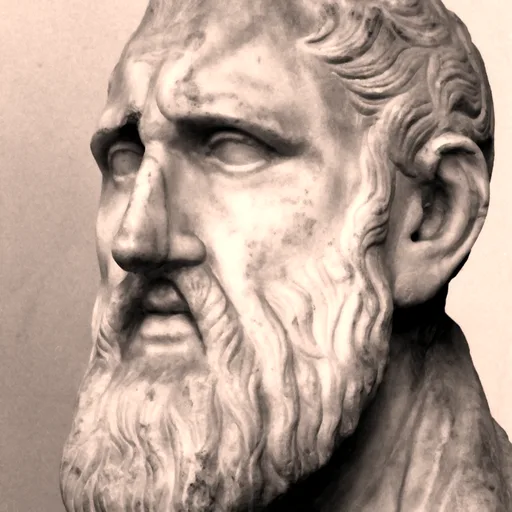
Epicurus
Greece -0341-01-01 ~ -0269-01-01
4th-century BCE ancient Greek philosopher
Defined the essence of pleasure as ataraxia — tranquility of mind through the removal of pain
His three-part classification of desires is a ready-made tool for reassessing consumption and career choices
Born on the island of Samos around 341 BCE, Epicurus was an ancient Greek philosopher who founded the Garden school in Athens and declared pleasure the highest good. Yet his pleasure was not sensual indulgence but ataraxia — tranquility of mind achieved by eliminating pain and anxiety. Inheriting Democritus's atomism and introducing the 'swerve' of atoms to ground free will, he became a founding figure of Hellenistic practical philosophy.
What You Can Learn
Epicurus's philosophy offers practical guidance for modern people living amid information overload and consumer culture. His three-part classification of desires — 'natural and necessary,' 'natural but unnecessary,' and 'vain desires' — can be directly applied to reassessing purchasing behavior and career choices. The craving for social-media validation and luxury brands falls under 'vain desires' in Epicurean terms: pursuing them never yields tranquility of mind. In business, the teaching that 'what is good is easy to obtain' is richly suggestive: management oriented toward 'enough' rather than profit maximization resonates with sustainable business and well-being-centered organizational design. In investing, too, recognizing the mental cost of chasing excessive returns and defining 'sufficient return' is an important perspective for long-term wealth building. And 'live unknown' reads as a contrarian strategy for choosing quiet productivity in an era of relentless self-branding.
Words That Resonate
Live unknown.
Lathe biosas.
Death is nothing to us; for what has been dissolved has no sensation, and what has no sensation is nothing to us.
Ho thanatos ouden pros hemas; to gar dialythen anaisthetei, to d' anaisthetoun ouden pros hemas.
The pleasant life is produced not by endless drinking and revelry but by sober reasoning.
Ou gar potous kai komous syneirous... all' ho nephalios logismos.
Just as medicine is useless if it does not drive out bodily disease, so philosophy is useless if it does not drive out suffering of the soul.
Pas ho tou philosophountos logos kenos, hyph' hou medemion pathos anthrouou therapeuetai. Hosper gar iatrikes ouk ophelos me tas nosous ton somaton ekballouses, houtos oude philosophias, ei me to tes psyches ekballei pathos.
When we say pleasure is the goal, we do not mean the pleasures of the dissolute or of sensual indulgence, but freedom from bodily pain and mental disturbance.
Hou to zetein hedone alla to hedeos zen... hoi gar logismoi kai nephalion kai sophon bion gennosi.
Bodily pain does not last without limit; intense pain is brief in duration.
Tes sarkos apeiron to algema, to de hyperalgoun oligochronion parestin.
Empty is the philosopher's argument that does not heal any human suffering.
Tes philosophias kenos ekeinou tou anthropou ho logos, hyph' hou medemion anthropou pathos therapeuetai.
Life & Legacy
Epicurus built a paradoxical philosophy: he named pleasure the highest good of life, then defined that pleasure as 'the absence of pain.' Posterity distorted 'Epicurean' into 'hedonist,' yet the real Epicurus pursued not the inflation of desire but its discernment and control in the service of the soul's peace. Twenty-three centuries later, his philosophy remains one of the most practical answers to the fundamental question of what happiness is.
Born on Samos to Neocles, an Athenian colonist, Epicurus held Athenian citizenship yet grew up on the periphery. He began studying philosophy around the age of fourteen and was deeply drawn to the atomism of Democritus. At eighteen he went to Athens for military service, and after the political upheavals following Alexander the Great's death, he migrated with his family to Asia Minor, moving through Colophon, Mytilene, and Lampsacus. Those itinerant years, shaping a philosophy immune to external circumstances, are believed to have motivated his search for an inner happiness independent of fortune.
Around 306 BCE Epicurus returned to Athens and purchased a house with a garden outside the city walls. This school, called 'the Garden' (Kepos), was revolutionary in admitting women and slaves — a sharp contrast with Plato's Academy and Aristotle's Lyceum. Residents lived communally, sharing simple meals of bread and water and practicing philosophy through daily conversation. For Epicurus, philosophy was not a doctrine delivered from a lectern but a way of life.
His system comprises three divisions: physics, epistemology (the Canon), and ethics. In physics, the innovative element was the parenklisis (clinamen, or 'swerve of atoms'). Atoms normally fall in straight lines, but occasionally undergo a minute, unpredictable deviation. This swerve causes collisions and combinations and, crucially, provides the physical basis for human free will — rescuing human agency from strict determinism. The ethical core is compressed into the Tetrapharmakos ('four-part cure'): God is not to be feared; death is nothing to us; what is good is easy to obtain; what is terrible is easy to endure. These four prescriptions target the four fundamental anxieties that plague human beings, demonstrating that Epicurean philosophy was not mere theory but a 'therapy of the soul.'
Epicurus reportedly wrote over three hundred works, but most are lost. What survives in connected form are three letters (to Herodotus, Pythocles, and Menoeceus), forty Principal Doctrines, and the Vatican Sayings. Yet his influence spread across the Mediterranean when the Roman poet Lucretius wove Epicurean atomism and ethics into the epic poem De Rerum Natura. By the late Republic, the Garden had grown into one of two dominant schools alongside the Stoa. In the Middle Ages, Christian opposition reduced Epicureanism to a caricature of hedonism, but Pierre Gassendi's 17th-century rehabilitation restored it as a precursor of modern empiricism and utilitarianism. The influence of Epicurean pleasure-pain calculus is clearly visible in John Locke's epistemology and Jeremy Bentham's utilitarianism. In his final years, Epicurus suffered excruciating pain from kidney stones yet reportedly wrote in his last letter to a friend that the memory of their conversations more than compensated for the agony — dying around 270 BCE as a practitioner of his own philosophy.
Expert Perspective
In the history of Western philosophy, Epicurus founded one of the two great ethical schools of the Hellenistic period alongside the Stoics. Ontologically he belongs to the materialist-atomist lineage, independently extending the natural philosophy he inherited from Democritus through the concept of the parenklisis (atomic swerve). His hedonism is classified as negative hedonism — pleasure defined as the absence of pain (aponia) and the tranquility of the soul (ataraxia) — and became one of the wellsprings of utilitarian philosophy. In epistemology, his Canon placed sensation as the criterion of knowledge, adopting an empiricist stance.