Entrepreneurs / Manufacturing
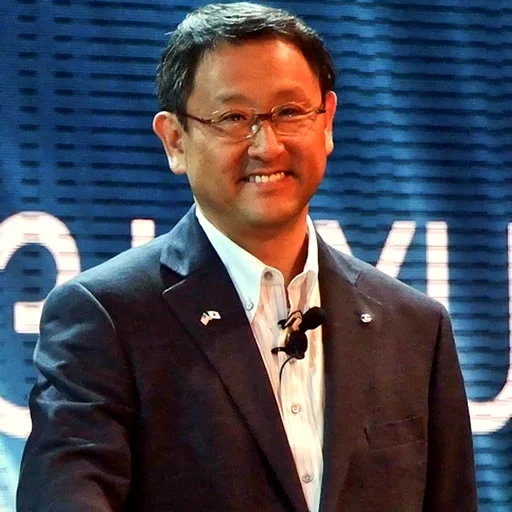
Akio Toyoda
Japan 1956-05-03
Showa-to-Reiwa era Toyota Motor Corporation executive and founding-family heir
Steered Toyota through recall and earthquake crises, leading a return to its core mission
The strategic power of returning to a business's essential value proposition when bureaucracy creeps in
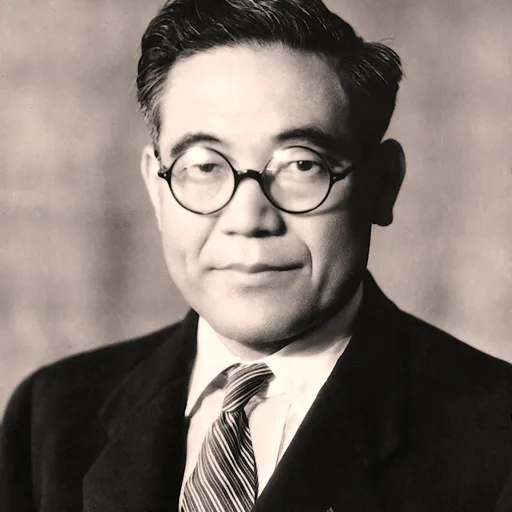
Born in Nagoya in 1956, Akio Toyoda is the grandson of Toyota Motor Corporation founder Kiichiro Toyoda and great-grandson of loom inventor Sakichi Toyoda. After earning an MBA from Babson College, he joined Toyota in 1984 and became president in 2009. He steered the company through the recall crisis and the Great East Japan Earthquake, and is known as a car enthusiast who races under the alias 'Morizo.' He stepped up to chairman in 2023, handing the presidency to Koji Sato.
What You Can Learn
Toyoda's leadership offers important lessons for modern entrepreneurs, particularly regarding organizational transformation and preserving a founder's spirit. First, the strategic power of 'returning to origins': the slogan 'let's make ever-better cars' appears simple, yet it demonstrates the force of returning to a business's core value proposition when a giant organization has become bureaucratized. It is a model for startups entering their growth phase and losing sight of their mission amid metrics management. Second, the value of a leader immersing themselves in the front line: Toyoda's racing served as a mechanism for transmitting a sense of product ownership throughout the organization — aligned with the principle that tech CEOs should be heavy users of their own products. Third, the multi-pathway strategy can be evaluated as a risk-diversification methodology in an era of high technological uncertainty. Rather than betting everything on a single technology, pursuing multiple options in parallel is a posture applicable to startup portfolio strategy.
Words That Resonate
Let's make ever-better cars.
もっといいクルマを作ろう。
I don't want to destroy Toyota. But I want to change it.
私はトヨタを壊したくない。でもトヨタを変えたい。
If there is no road, make your own.
道がなければ、自分で道を作る。
Life & Legacy
Akio Toyoda is the third-generation founding-family leader who ran one of the world's largest automakers while striving to restore the passion for craftsmanship to a giant organization. His leadership embodies the tension between managing a global corporation and preserving a founding family's identity.
Born in 1956 in Nagoya, Aichi Prefecture, Toyoda graduated from Keio University's Faculty of Law before earning an MBA at Babson College in the United States. He joined Toyota in 1984. As heir apparent of the founding family, he was perpetually conscious of how he was perceived within the company, and built his track record across diverse domestic and international divisions, including overseas business expansion and the launch of Gazoo Media Service (later GAZOO).
He assumed the presidency in 2009 and immediately confronted an unprecedented cascade of crises. A massive recall over accelerator-pedal defects in 2009-2010 escalated until Toyoda himself testified before the U.S. Congress. The 2011 Great East Japan Earthquake and Thai floods then inflicted devastating blows to the supply chain, prompting an industry-wide reassessment of supply-chain risk management.
Navigating these crises, Toyoda placed a deceptively simple slogan at the center of his management: 'Let's make ever-better cars.' Behind the phrase lay an acute awareness that Toyota's relentless pursuit of efficiency and margins during its expansion into a corporate giant had eroded the joy of making and driving cars. He drove the TNGA (Toyota New Global Architecture) platform strategy to raise the baseline of vehicle dynamics and quality.
The most distinctive aspect of Toyoda's leadership is his personal participation in motorsport as a racing driver under the alias 'Morizo.' In WRC (World Rally Championship) and WEC (World Endurance Championship) events where Toyota competes, he appears not just as an owner but behind the wheel — a visible assertion of his identity as a 'car person.' He operates Rookie Racing, his own racing team, and has used motorsport as a proving ground for new technologies, including hydrogen-engine vehicles.
On EV strategy, Toyoda staked out a distinctive position. Rather than rushing toward an all-electric transition like many Western automakers, he advocated a 'multi-pathway' approach encompassing hybrids, plug-in hybrids, hydrogen fuel cells, and battery EVs. This stance drew criticism from environmental activists and some investors, but the slowdown in EV market growth from 2024 onward has prompted some re-evaluation.
In April 2023, he stepped down as president, entrusting the role to Koji Sato while becoming chairman. As of 2023, Toyoda holds the French Legion of Honour (Officer) and Japan's Medal with Blue Ribbon. His fourteen years at the helm — wrestling with how to reconcile the governance demands of a vast organization with the founding spirit of craftsmanship — constitute an important case study in the evolution of Japanese family businesses.
The 'Morizo' persona is not merely a hobby but a management strategy for recovering shop-floor instincts when an organization has grown too large. Placing himself in the extreme conditions of racing to verify vehicle performance with his own body is a contemporary form of the founder's commitment to the gemba (the actual workplace). As chairman, Toyoda's ultimate managerial legacy remains an evolving story, one whose verdict will shift alongside the fortunes of his multi-pathway EV strategy.
Expert Perspective
Among entrepreneurial archetypes, Toyoda is classified as a 'transformational third-generation founding-family leader.' The challenge of inheriting the enterprise built by founders (Sakichi and Kiichiro) and re-injecting the founding spirit into a massive organization parallels the situations faced by Walmart's Rob Walton and Ford's Bill Ford. Toyoda's distinctiveness lies in maintaining a direct connection to the front line through the 'Morizo' persona, making his passion for the product visible. As of 2023, he continues to be involved in management as chairman; his ultimate assessment remains a work in progress.