Scientists / Chemistry
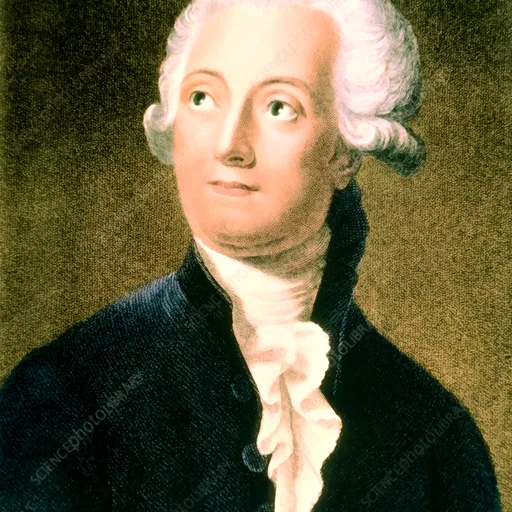
Antoine Lavoisier
France 1743-08-26 ~ 1794-05-08
Eighteenth-century French chemist
Established the law of conservation of mass and dismantled phlogiston theory
Called the father of modern chemistry, he was executed during the Reign of Terror
French chemist born in 1743 who discovered the law of conservation of mass, named oxygen, and demolished phlogiston theory. He is called the father of modern chemistry. Executed during the French Revolution.
What You Can Learn
Lavoisier's insistence on measuring inputs and outputs is the prototype of quantitative analysis in business. His systematic nomenclature shows the power of shared terminology in improving team communication. And his overthrow of phlogiston theory reminds professionals that even widely accepted models must yield to empirical evidence. His tragic execution during the Revolution is a stark reminder that political instability can destroy irreplaceable intellectual capital, a risk factor for any society investing in human talent.
Words That Resonate
Nothing is lost, nothing is created, everything is transformed.
Rien ne se perd, rien ne se crée, tout se transforme.
It is almost impossible to make a clear and accurate statement about chemistry without resorting to the language of weights and measures.
It is almost impossible to make a clear and accurate plan of scientific research without first performing the experiments.
It took but an instant to cut off that head, and a hundred years may not suffice to produce another like it.
Il ne faut qu'un instant pour couper cette tête, et cent ans ne suffiront peut-être pas pour en reproduire une semblable.
Life & Legacy
Antoine Lavoisier transformed chemistry from a qualitative craft into a quantitative science. By applying precise measurement to chemical reactions, he proved that mass is conserved, identified oxygen's role in combustion, and dismantled the phlogiston theory that had dominated for a century.
Born in 1743 in Paris to a wealthy family, he studied law at his father's wish but was drawn to science. He joined the Royal Academy of Sciences at twenty-five and quickly made his mark through meticulous experimental work.
His most famous experiment involved heating mercury in a sealed vessel, showing that the metal gained weight by combining with a component of air. He named this component "oxygen" and demonstrated that combustion and respiration are both oxidation processes. The insight overthrew phlogiston theory, which held that a mysterious substance was released during burning.
Lavoisier established the law of conservation of mass: in a chemical reaction, the total mass of the reactants equals the total mass of the products. He co-authored a systematic chemical nomenclature still in use and published the landmark Traite Elementaire de Chimie (1789), sometimes called the first modern chemistry textbook.
He also served as a tax collector through the Ferme Generale, a role that brought wealth but ultimately cost his life. During the Reign of Terror he was arrested, tried, and guillotined on 8 May 1794. Lagrange reportedly lamented that the Revolution had taken only an instant to cut off a head that a century could not replace.
Lavoisier's insistence on quantitative measurement made chemistry a precise science and set a methodological standard that spread across the natural sciences.
Expert Perspective
Among scientists, Lavoisier is the founder of modern chemistry. He replaced qualitative speculation with quantitative measurement, established the conservation of mass, and created a chemical nomenclature that endures. His execution during the Revolution is one of the most tragic losses in the history of science.