Scientists / Physics
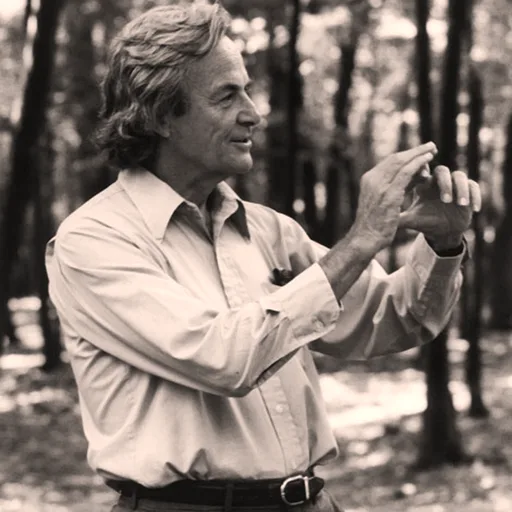
Richard Feynman
United States 1918-05-11 ~ 1988-02-15
Twentieth-century American theoretical physicist
Reformulated quantum electrodynamics and invented the Feynman diagram
A consummate communicator who conveyed the joy of scientific inquiry to both students and the public
American theoretical physicist born in 1918 who reformulated quantum electrodynamics and invented the Feynman diagram. Won the 1965 Nobel Prize in Physics.
What You Can Learn
Feynman's dictum "you must not fool yourself" is a direct warning against confirmation bias in data analysis and project evaluation. His Feynman diagrams demonstrate the power of visualizing complex problems, a principle echoed in business dashboards and model canvases. And his independent stance during the Challenger investigation exemplifies the value of intellectual honesty over organizational conformity, a lesson for any professional facing pressure to suppress inconvenient findings.
Words That Resonate
Life & Legacy
Richard Feynman combined a rare intuitive grasp of physics with an extraordinary gift for explanation. His reformulation of quantum electrodynamics (QED) underpins modern particle physics, and the Feynman diagram he devised remains an indispensable tool for visualizing subatomic interactions.
Born in 1918 in Far Rockaway, New York, he grew up with a father who instilled the habit of asking why. He studied physics at MIT and completed his doctorate under John Wheeler at Princeton. At twenty-four he joined the Manhattan Project, leading a computation group at Los Alamos. The experience left a lasting imprint on his thinking about science and social responsibility.
After the war, Feynman attacked the central problem of QED: calculations that produced infinities. Using his path-integral formulation and renormalization technique, he tamed the infinities and shared the 1965 Nobel Prize with Tomonaga and Schwinger. The Feynman diagram translated complex particle interactions into intuitive pictures of lines and vertices, dramatically clarifying calculations.
His undergraduate lectures at Caltech (1961-1963), published as The Feynman Lectures on Physics, became one of the most influential physics textbooks worldwide. Rejecting rote formulas, he taught students to grasp phenomena from first principles.
In 1986 he served on the Rogers Commission investigating the Challenger shuttle disaster. His ice-water demonstration of O-ring brittleness made the failure cause vivid to the public and exposed institutional decision-making failures. His bestselling memoir, Surely You're Joking, Mr. Feynman!, brought the joy of scientific curiosity to a mass audience. He died of kidney cancer in 1988.
Expert Perspective
Among scientists, Feynman is both a major contributor to QED and a pioneer of science communication. The path-integral formulation and the Feynman diagram are two methodological innovations now standard in particle physics. That Tomonaga and Schwinger independently reached similar results is a striking case of simultaneous discovery. His Challenger investigation also demonstrates a scientist's public responsibility.