Artists / Post-Impressionism
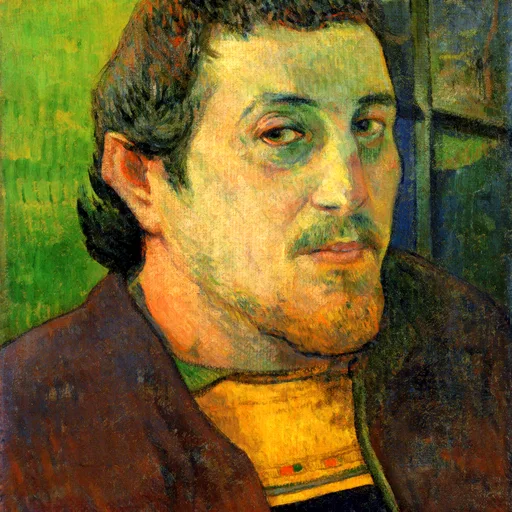
Paul Gauguin
France 1848-06-07 ~ 1903-05-08
French Post-Impressionist painter born in Paris in 1848
Abandoned finance for art and sailed to Tahiti, creating vivid symbolic paintings in flat color
His existential questions and cross-cultural practice remain as provocative and debated as ever
Born in Paris in 1848, Gauguin abandoned finance to paint and sailed to Tahiti seeking a primitive paradise. His flat color planes and symbolic subjects bridge Impressionism and early modernism.
What You Can Learn
Gauguin holds lessons of mixed valence. His leap from stable career to art is an extreme case of risk-taking, inspiring yet shadowed by abandoned family responsibility. His cross-cultural borrowing shows both the creative power and ethical pitfalls of drawing on other traditions, a tension relevant to global creators. And his painting title, distilling existential questions into one line, models the power of framing the right question, vital in mission statements as in art.
Words That Resonate
Life being only a fraction of a second in eternity, one should at least make it bearable.
La vie n'étant qu'une fraction de seconde dans l'éternité, on devrait au moins la rendre supportable.
Where do we come from? What are we? Where are we going?
D'où venons-nous? Que sommes-nous? Où allons-nous?
Art is either a plagiarist or a revolutionary.
L'art est ou bien un plagiaire, ou bien un révolutionnaire.
Life & Legacy
Paul Gauguin occupies a unique place because he broke away from Impressionism's pursuit of light and turned instead to flat color planes and symbolic subjects, shifting painting toward inner, spiritual expression. His move from bourgeois Paris to Polynesia also raises enduring questions about cultural encounter, idealization, and artistic ethics.
Born June 7, 1848, in Paris to a journalist father and a mother of Peruvian-Spanish descent, he spent part of his childhood in Lima, a memory that fed his later longing for the exotic. In 1883, at thirty-five, he quit his job to paint full-time, a decision that cost him his marriage and his five children.
In 1886 at Pont-Aven in Brittany he developed Synthetism with Emile Bernard: bold outlines enclosing flat areas of color, a style indebted to stained glass and Japanese woodcuts. In 1888 he spent two turbulent months with Van Gogh in Arles, ending in the ear crisis.
In 1891 he sailed for Tahiti seeking a primitive paradise free of Western corruption. However, the Tahiti he found was already altered by French colonialism, and critics note that his paradise was partly a projection of his own ideals.
Where Do We Come From? What Are We? Where Are We Going?, painted in 1897-98, is his artistic testament. It was reportedly created just before a suicide attempt, concentrating disillusionment and spiritual searching at their most intense.
His technique, called Cloisonnism, encloses flat color within heavy outlines, boosting chromatic intensity by a method opposite to Impressionist broken brushwork. The Nabis and the Fauves drew directly from this approach.
He died May 8, 1903, in the Marquesas Islands at fifty-four, ill and impoverished. His legacy is both artistically rich and ethically complex, raising ongoing debates about cultural appropriation and the idealization of the Other.
Expert Perspective
Gauguin bridges Post-Impressionism and Symbolism, turning painting toward inner expression through flat color and symbolic subjects. Cloisonnism, bold outlines with flat color, directly influenced the Nabis and Fauvism. His Tahitian works pioneered artistic engagement with non-Western cultures, though they are now re-examined through postcolonial critique.