Entrepreneurs / Manufacturing
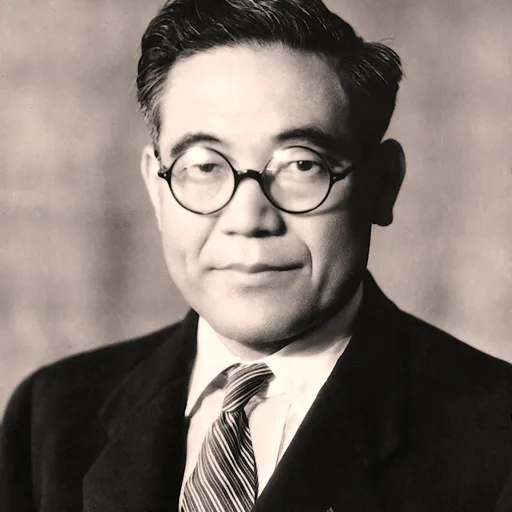
Kiichirō Toyoda
Japan 1894-06-11 ~ 1952-03-27
20th-century Japanese industrialist and founder of Toyota Motor Corporation
Achieved mass production of a domestic passenger car and laid the foundations of the Toyota Production System
Just-in-time — born of constraint — became a global manufacturing standard
Born in Shizuoka Prefecture, Japan, in 1894, Kiichiro Toyoda was the eldest son of Sakichi Toyoda, the inventor of the automatic loom. After studying mechanical engineering at Tokyo Imperial University, he supported his father's textile-machinery business while researching automotive engineering. In 1937 he established Toyota Motor Corporation and took on the challenge of mass-producing a domestically made passenger car. A postwar financial crisis forced his resignation as president in 1950; he died suddenly in 1952 at the age of 57, just before his planned return. He is the intellectual wellspring of the Toyota Production System.
What You Can Learn
Kiichiro's enterprise-building offers lessons with particularly deep implications for innovation under resource constraints. First, 'invention born of constraint': Japan's scarcity of resources gave rise to just-in-time, a manufacturing philosophy that became a global standard. When startups build businesses with limited capital and personnel, constraints can become the mother of ingenuity. Second, technology transfer from an existing business: Kiichiro repurposed the precision-machining techniques and quality-control methods cultivated in loom manufacturing for automobile production. Cross-domain technology transfer is an essential perspective in startup pivots as well. Third, the manner of accepting managerial responsibility: Kiichiro's resignation over employee layoffs poses the question of what accountability today's executives owe to their stakeholders — shareholders, employees, and customers alike. Finally, the continuation of vision across generations: Kiichiro's translation of Sakichi's teaching — 'build things that serve the world' — into the automobile industry embodies the universal theme of how a founder's philosophy is carried forward.
Words That Resonate
Before you say it can't be done, try it first.
できないという前に、まずやってみろ。
We must build automobiles suited to Japan, with Japanese hands.
日本人の手で、日本に合った自動車を造らなければならない。
Supply parts just in time. That is the most waste-free method.
ジャスト・イン・タイムで部品を供給する。それが最も無駄のない方法だ。
Life & Legacy
Kiichiro Toyoda was the entrepreneur who connected the technical innovation his father Sakichi achieved in looms to the automobile industry. Driven by the conviction that 'Japanese hands must build automobiles,' he constructed a mass-production system under the resource constraints of prewar Japan. His short life was a story of fierce tension between an engineer's dream and the realities of management.
Born in 1894 in Yoshitsu Village, Shikichi District, Shizuoka Prefecture (present-day Kosai City), Kiichiro was the eldest son of Sakichi Toyoda, already renowned as the inventor of the automatic loom. He inherited a natural affinity for machines. He studied mechanical engineering at the Faculty of Engineering of Tokyo Imperial University, graduating in 1920 and joining his father's Toyoda Boshoku (Toyoda Spinning and Weaving).
The turning point came during a tour of Europe and the United States in 1921-1922. While visiting textile mills in Britain and America, he witnessed firsthand the rapid spread of the automobile as social infrastructure. Ford's mass-production methods left a particularly powerful impression. This experience planted the idea of shifting from looms to automobiles.
Back in Japan, Kiichiro began independent research into automobile engines while continuing his father's business. In 1933 he established an automotive division within Toyoda Automatic Loom Works and set about mastering engine technology through a hands-on approach — disassembling Chevrolet engines to study their construction. By 1935 he had successfully prototyped the A1 passenger car and the G1 truck, and in 1936 mass sales of a 'domestically produced people's car' began. In 1937 he spun off the automotive division into Toyota Motor Co., Ltd. The decision to spell the company name 'Toyota' rather than the family name 'Toyoda' is attributed to considerations of auspicious stroke count and euphony.
The single most important element of Kiichiro's manufacturing philosophy is the concept of 'just-in-time': supply the right parts, at the right time, in the right quantity. Although Taiichi Ohno later systematized it as the Toyota Production System, the original concept was Kiichiro's. Japan's scarcity of materials made the American model of stockpiling large inventories impractical. That constraint gave birth to the Japanese manufacturing philosophy of relentlessly eliminating waste.
During the war, production centered on military trucks, and the original goal of mass-producing passenger cars was suspended. In 1947 the Toyopet SA was launched, but severe cash shortages and a pre-Korean War recession caused financial deterioration. In 1950 a labor dispute erupted over mass layoffs, and Kiichiro resigned as president, accepting managerial responsibility. His resignation is said to reflect his conviction that if employees are asked to sacrifice, the executive must bear accountability as well.
In 1952, as Korean War demand restored Toyota's fortunes, Kiichiro's return as president was decided. But just before his reinstatement he died of a cerebral hemorrhage at the age of 57 — his work left unfinished.
Kiichiro's legacy extends well beyond Toyota Motor Corporation itself. The just-in-time philosophy became a foundational principle of manufacturing worldwide, codified as lean production. And the attitude of overcoming resource constraints through ingenuity became a spiritual pillar of Japanese craftsmanship. Connecting the technological lineage that began with his father Sakichi's looms to the automobile and laying the foundation of one of the world's preeminent automakers, Kiichiro's story is also an embodiment of technological vision sustained across generations. His premature death was a profound loss for the Japanese automobile industry, but the manufacturing philosophy he left behind was carried forward by subsequent leaders and engineers, becoming the driving force that propelled Toyota to the top of the global industry.
Expert Perspective
Among entrepreneurial archetypes, Kiichiro is classified as an engineer-origin, industry-creating entrepreneur. Where Henry Ford invented the mass-production system, Kiichiro germinated a distinctively Japanese manufacturing philosophy of efficient production under resource constraints. As a second-generation leader who inherited his father's business yet challenged an entirely new industry, he is also a pioneering case of innovation by a successor. In contrast to Soichiro Honda, who was a fiercely independent engineer, Kiichiro placed greater emphasis on organizational technology development and the construction of mass-production systems.