Philosophers / Modern Western
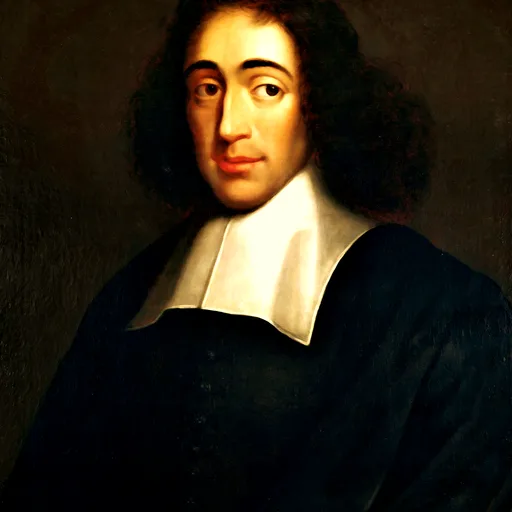
Benedictus de Spinoza
Netherlands 1632-11-24 ~ 1677-02-21
17th-century Dutch rationalist philosopher
Demonstrated the identity of God and Nature in the Ethics using the geometric method
The technique of recognizing the causes of emotion through reason and controlling them is a fundamental principle of stress management
Born in Amsterdam in 1632, Baruch de Spinoza was a heretical philosopher who was excommunicated from the Jewish community and earned his living grinding lenses. In his masterwork Ethics, he used the geometric method to demonstrate the identity of God and Nature, establishing himself — alongside Descartes and Leibniz — as one of the pillars of early-modern rationalism. His pantheistic worldview deeply impressed thinkers from Goethe to Einstein and quietly shaped the currents of modern thought.
What You Can Learn
Spinoza's philosophy offers three practical insights for a modern world saturated with information and stress. First, the approach of 'controlling emotions through understanding': he argued that when the causes of passive emotions are clearly recognized by reason, those emotions lose their power. This overlaps with the basic principles of cognitive behavioral therapy and stress management, and can be applied as a technique for avoiding anger- or anxiety-driven decisions in business settings. Second, releasing attachment to outcomes: Spinoza's determinism may appear passive at first glance, but the discipline of calmly distinguishing what one can and cannot control, then concentrating on the controllable, is extremely effective in project management and risk assessment. Third, finding value in the act itself rather than in external rewards: the example of a philosopher who sought neither fame nor fortune, grinding lenses while pursuing philosophy, is a prototype for an intrinsically motivated career design that does not depend on extrinsic incentives.
Words That Resonate
Blessedness is not the reward of virtue but virtue itself.
Beatitudo non est virtutis praemium, sed ipsa virtus.
A free man thinks of nothing less than of death, and his wisdom is a meditation not on death but on life.
Homo liber de nulla re minus quam de morte cogitat; et eius sapientia non mortis sed vitae meditatio est.
All determination is negation.
Omnis determinatio est negatio.
I have striven not to laugh at human actions, not to weep at them, nor to hate them, but to understand them.
Sedulo curavi, humanas actiones non ridere, non lugere, neque detestari, sed intelligere.
God, or Nature.
Deus sive Natura
Life & Legacy
Baruch de Spinoza was a philosopher who, in the Dutch Golden Age, turned his back on both religious authority and worldly fame, relying on the freedom of thought alone. Born in 1632 in Amsterdam into a family of Portuguese Jews who had fled persecution on the Iberian Peninsula, young Baruch received a traditional Jewish education, studying the Hebrew Scriptures and the Talmud. But his intellectual curiosity would not be contained within the community: he taught himself Latin, and voraciously absorbed Descartes's writings and the new findings of natural science.
In 1656, at twenty-three, the Portuguese Jewish congregation of Amsterdam issued a permanent ban of excommunication against him. The precise reasons are not recorded in the official documents, but skepticism toward the divine authority of Scripture and denial of the immortality of the soul are believed to have been at issue. The expulsion cut him off entirely from communal and family support but simultaneously freed him from the shackles of doctrine. Thereafter Spinoza chose to earn his daily bread by grinding lenses — meticulous precision work — while living simply near The Hague and devoting himself to philosophical inquiry.
The core of Spinoza's thought is a monism holding that there exists only one substance, which can equally be called God or Nature. He explicitly rejected the personal God of traditional religion — a transcendent being who watches over and judges humanity from outside the world. In its place he offered the formula 'Deus sive Natura' — God, or Nature. The world itself is an expression of God; mind and matter are merely different attributes of the same substance. This view also served as a fundamental response to Descartes's mind-body dualism.
The Ethics is structured throughout in the demonstrative format of geometry: definitions, axioms, propositions, and proofs. This methodological choice carries deep intent: to elucidate the most subjective domains of human experience — ethics and emotion — under the same necessity as mathematics. The denial of free will follows necessarily from this system: human actions are part of the chain of natural laws, and freedom is an illusion born of ignorance of external causes. But Spinoza does not stop there. He argues that grasping the causal web of nature through reason is the only path to liberation from the bondage of the emotions. When one transitions from passive subjection to active understanding, one gains greater power and joy — what he calls 'freedom of the mind.'
The Ethics was not published during his lifetime. His other major work, the Theologico-Political Treatise, was published anonymously in 1670 but provoked such shock — subjecting the authority of both church and state to the tribunal of reason — that it was banned. Its argument that the state should guarantee freedom of speech and thought positions it as a precursor of European Enlightenment thought.
Spinoza's influence permeated slowly after his death. He died in 1677 at the age of forty-four — lung disease attributed in part to the dust from lens-grinding — and the Ethics was published posthumously from his manuscripts. Through Lessing in the 18th century his thought flowed into German Idealism, leaving deep marks on Kant, Hegel, and Schelling. Einstein's well-known statement that 'I believe in Spinoza's God' illustrates the breadth of a philosophical vision that resonates with 20th-century scientific worldviews. A philosopher who sought neither honor nor wealth throughout his life, his thought continues to be referenced at the intersection of philosophy, science, and political theory more than 300 years after his death.
Expert Perspective
In the history of Western philosophy, Spinoza occupies a distinctive position: he overcame Descartes's mind-body dualism with monism and stands at the opposite pole from Leibniz's pluralistic monadology. While belonging to the rationalist lineage, his thoroughgoing pantheism — denying a personal God — fundamentally rewrote the boundary between religion and philosophy. Placing ontology over epistemology and attempting to describe ethics as a dynamics of emotion in natural-scientific terms, his methodology extends its reach to German Idealism, 20th-century structuralism, and the thought of Gilles Deleuze.