Entrepreneurs / Industrial Pioneer
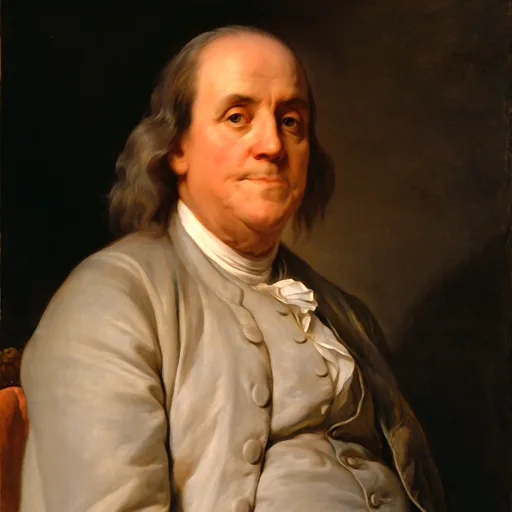
Benjamin Franklin
United States 1706-01-17 ~ 1790-04-17
18th-century American statesman, scientist, and entrepreneur
Made his fortune in printing, invented the lightning rod, and helped build the United States
He designed the prototype of subscription media 250 years ahead of its time
Born in Boston in 1706, the fifteenth child of a candle maker. Benjamin Franklin was apprenticed to his brother's print shop at twelve and struck out alone for Philadelphia at seventeen. He made his fortune in the printing trade and published Poor Richard's Almanack for 25 years, building a prototype of the media business. After retiring from operations at 42, he pivoted to science, diplomacy, and nation-building — the polymath who stands at the origin of America's entrepreneurial spirit.
What You Can Learn
Franklin's business methods speak directly to today's entrepreneurs. First, content-business design: Poor Richard's Almanack combined practical information with aphorisms in a consumable format that required repurchasing every year, producing a steady revenue stream. It is the prototype of the subscription-media model and structurally identical to today's newsletter-revenue businesses. Second, the prescience of franchise expansion: placing print partners across different cities and providing them with brand and know-how is modern licensing in all but name. Third, his strategic retirement at 42 mirrors the principles of the FIRE movement and serial entrepreneurship: systematize, delegate, and redirect one's time toward the next challenge. And the most immediately applicable lesson is his '13 virtues' habit system: breaking goals into small units, working on them weekly, and tracking progress in a notebook anticipates habit trackers and the sprint methodology of agile development. As a methodology for managing personal growth through systems, it remains as practical now as it was 250 years ago.
Words That Resonate
Life & Legacy
Benjamin Franklin built a diversified empire of enterprise and civic activity on a printing-press foundation in 18th-century America, then went on to play a central role in the Revolution and the construction of the new republic. He was the earliest serial entrepreneur in recognizable form, and the first notable case of someone who deliberately designed the full lifecycle of a business: build, scale, delegate, and retire.
Born in 1706 in Boston, the fifteenth of seventeen children of a candle-and-soap maker, he received only two years of formal schooling but burned with a thirst for self-education. At twelve he was apprenticed to his brother James's print shop, where he honed his writing skills while setting type. He submitted essays to his brother's newspaper under the fictional persona of Silence Dogood, winning readers' admiration — early evidence that he understood the power of content. Yet friction with his brother grew, and at seventeen Franklin broke his apprenticeship contract and fled to Philadelphia.
His first years there were difficult, but a co-founded print shop in 1728 proved the turning point. The following year he purchased The Pennsylvania Gazette and expanded its circulation with clear prose and practical articles. In 1732 he launched Poor Richard's Almanack, the venture that propelled his fortunes. The almanac combined astronomical data and farming calendars with maxims such as 'Early to bed and early to rise, makes a man healthy, wealthy, and wise.' This fusion of practical information and entertainment sold roughly 10,000 copies a year, making it one of the most widely read periodicals in the colonies. Franklin also pioneered a franchise model for his print business, placing partners in different cities and sharing profits — a concept that anticipates the modern licensing business.
Having achieved financial independence, Franklin stepped back from day-to-day operations at the age of 42, securing a pension-like stream of income while handing management to his partner. This decision epitomizes his entrepreneurial brilliance: rather than pouring ever more time into a growing business, he systematized the operation, delegated it, and moved on to the next challenge. In retirement he threw himself into scientific experiments, demonstrating the electrical nature of lightning with his famous kite and key and inventing the lightning rod, bifocal glasses, and other practical devices.
Particularly noteworthy in Franklin's intellectual legacy is the system of '13 virtues' described in his autobiography. He listed temperance, silence, order, resolution, frugality, industry, sincerity, justice, moderation, cleanliness, tranquility, chastity, and humility, and created a notebook in which he focused on one virtue per week and tracked his progress. He admitted that he never achieved perfection in any of them, but the system itself is what matters: he translated moral ideals from abstract aspirations into measurable behavioral targets and iterated on them in a cycle resembling the PDCA method — making him a conceptual ancestor of modern habit-tracking apps and OKRs.
In politics and diplomacy, Franklin served on the committee that drafted the Declaration of Independence, secured French military support as ambassador to Paris, and became a signatory to the Constitution. He is the only Founding Father to have signed all three documents: the Declaration of Independence, the Treaty of Paris, and the Constitution. In his later years he served as president of the Pennsylvania Abolition Society, reversing his own earlier history as a slaveholder.
From journeyman printer to media entrepreneur, scientist, diplomat, and architect of a nation, Franklin's life was a trajectory of compounding knowledge and relationships across domains. That his portrait appears on the American hundred-dollar bill — the highest denomination — signifies that American society chose to honor a symbol of self-reliance over political power.
Expert Perspective
Among entrepreneurial archetypes, Franklin is neither a technological innovator nor a financial capitalist but an 'organizer of the knowledge industry.' He controlled the printing platform, generated added value with information content, and expanded geographically through franchising — a strategy that was unusual in an 18th century dominated by manufacturing. Moreover, his decision to systematize his business and retire at 42, pivoting to public works, science, and diplomacy, presents an entrepreneurial model that places self-fulfillment and social contribution above business creation itself. As the headwater of both serial entrepreneurship and social entrepreneurship, he occupies a position distinct from Carnegie or Rockefeller.