Writers & Literary Figures / Existentialism
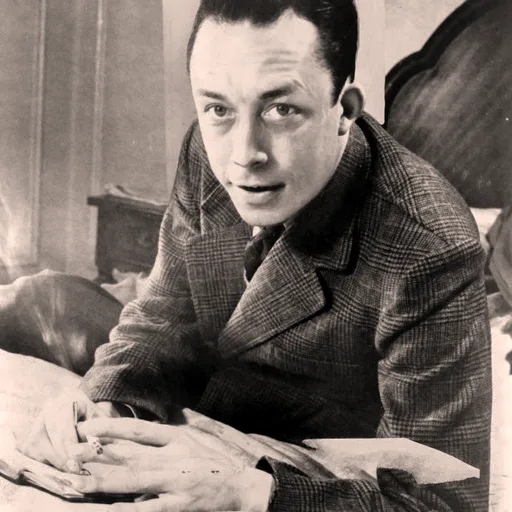
Albert Camus
France 1913-11-07 ~ 1960-01-04
20th-century French writer and philosopher of the absurd
Affirmed revolt against the absurd in The Stranger and The Myth of Sisyphus
Finding meaning in effort without guaranteed results is the core of the entrepreneurial spirit
Born in French Algeria in 1913, Albert Camus grew up in poverty amid the Mediterranean light and the shadow of death. He crystallized the concept of 'the absurd' in The Stranger and The Myth of Sisyphus, affirming that even in a meaningless universe, defiant persistence gives human life its dignity. He received the Nobel Prize in Literature at 44 in 1957. After his break with Sartre, he held firm to a philosophy of freedom and solidarity that refused to be co-opted by ideology.
What You Can Learn
Camus's philosophy of the absurd offers practical guidance for anyone navigating an unpredictable age. The conclusion 'one must imagine Sisyphus happy' is an attitude that finds meaning in effort even when the outcome is not guaranteed — direct encouragement for entrepreneurs working in an environment where more than 90% of startups fail, or professionals engaged in long-term projects with invisible results. Crucially, Camus is not preaching optimism; he is modeling the decision to act after squarely confronting despair — a stance that resonates with cognitive behavioral therapy's principle of choosing action rather than being ruled by emotion. The concept of 'rebellion that knows its limits,' developed in The Rebel, provides a framework for thinking about the ethics of organizational dissent and whistleblowing: how far should one go in the name of justice? This question sits at the heart of corporate compliance and ESG management. And the ethic of solidarity depicted in The Plague — how individuals should behave in the face of uncontrollable catastrophe — remains a universal text worth rereading in every crisis.
Words That Resonate
In the midst of winter, I found there was, within me, an invincible summer.
Au milieu de l'hiver, j'ai decouvert en moi un invincible ete.
Nothing in the world is worth turning away from what we love.
Rien au monde ne vaut qu'on se detourne de ce qu'on aime.
I rebel, therefore we exist.
Je me revolte, donc nous sommes.
There is but one truly serious philosophical problem, and that is suicide.
Il n'y a qu'un probleme philosophique vraiment serieux : c'est le suicide.
One must imagine Sisyphus happy.
Il faut imaginer Sisyphe heureux.
The struggle itself toward the heights is enough to fill a man's heart.
La lutte elle-meme vers les sommets suffit a remplir un coeur d'homme.
Life & Legacy
The question Albert Camus planted at the crossroads of philosophy and literature is strikingly direct: 'Does life have meaning? And if it does not, is it worth living?' His answer was paradoxical yet powerful: acknowledge the absence of meaning, and affirm life nonetheless. This is the philosophy of the absurd, and it occupies a unique set of coordinates in 20th-century intellectual history.
Born in 1913 in Mondovi, French Algeria, Camus lost his father in World War I the following year. His mother was nearly illiterate and partially deaf, supporting the family as a cleaning woman in a cramped apartment in the Belcourt district. The boy who grew up in a home without electricity or books was transformed by his encounter with Louis Germain, his primary-school teacher. Germain recognized Camus's talent, persuaded his mother to send him to secondary school, and opened the path to a scholarship. After receiving the Nobel Prize, Camus immediately wrote Germain a letter of thanks, and his posthumous novel The First Man bears the imprint of his deep gratitude.
While studying philosophy at the University of Algiers, Camus contracted tuberculosis at seventeen — an experience that left a decisive mark on his thought. Living in proximity to death from a young age is said to have bred his distrust of abstract philosophical systems and his inclination toward a bodily, sensory affirmation of life. His early essays Betwixt and Between and Nuptials, celebrating Mediterranean sunlight, the sea, and physical joy, contain the embryo of his later absurdist philosophy: human beings inevitably die, the world does not answer our call, and yet the sunlight is beautiful. The simultaneous affirmation of this contradiction lies at the root of Camus's thought.
In 1942, at twenty-nine, the novel The Stranger and the philosophical essay The Myth of Sisyphus catapulted him to international renown. Meursault, the protagonist, sheds no tears at his mother's funeral, kills an Arab because of the glare of the sun, refuses to show remorse at his trial, and is sentenced to death — a figure who exposes the fictions of modern morality by refusing the emotional performances society demands. Meanwhile, The Myth of Sisyphus opens with the sentence 'There is but one truly serious philosophical problem, and that is suicide,' and finds in Sisyphus — condemned to push a boulder to the summit only to watch it roll back down, forever — an image of a human being who, fully conscious of the absurd, chooses to go on living. The essay concludes: 'One must imagine Sisyphus happy.'
During World War II, Camus served in Paris as editor of Combat, the Resistance underground newspaper, writing anonymous editorials of defiance. The Plague, published after the war, depicted the fight against an epidemic sweeping the Algerian city of Oran and was read as a narrative of collective revolt and solidarity against the absurd. The passage in which Dr. Rieux names the reason he fights the plague as 'decency' encapsulates Camus's ethics. The novel was widely re-read during the pandemic of the 2020s as a universal text asking how individuals should act and unite in the face of uncontrollable catastrophe.
The Rebel, published in 1951, criticized the structure by which revolution justifies murder in the name of justice, arguing that only rebellion aware of its own limits can preserve human freedom. This work triggered the definitive break with Sartre. Where Sartre inclined toward tolerating violence in the name of historical progress, Camus would not yield: 'No cause justifies the death of a single child.' Their dispute was not a personal feud but a fundamental fork in political philosophy: whether ends can justify means.
In 1957, at forty-four, Camus received the Nobel Prize in Literature — awarded during the Algerian War. He sided with neither the independence movement nor the colonial establishment, choosing the isolated position of calling for an end to violence against civilians. His remark — 'I believe in justice, but I will defend my mother before justice' — was controversial but condensed his ethic of placing concrete human life above abstract ideology. On January 4, 1960, he was killed in a car accident at the age of forty-six; in his bag was the unfinished manuscript of The First Man.
Expert Perspective
In philosophical history, Camus is often grouped under existentialism, but he consistently rejected the label. His position forms its own domain as 'the philosophy of the absurd.' Where Kierkegaard and Jaspers treated the absurd as an occasion for a leap of faith, Camus refused transcendence and chose to remain within the absurd. Where Sartre emphasized freedom and historical action, Camus set ethical limits on revolt — a fundamental divergence. His thought, rooted in Mediterranean sensibility and the landscape of North Africa, privileges ethics over ontology and concrete human experience over systematic theory.