Artists / Modern
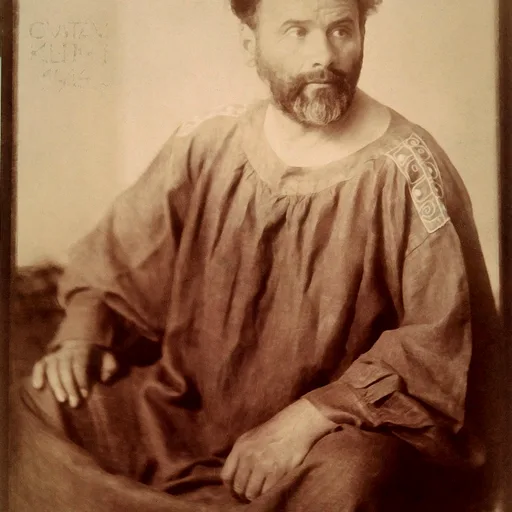
Gustav Klimt
Austria 1862-07-14 ~ 1918-02-06
Austrian painter born in Vienna in 1862, co-founder of the Vienna Secession
Fused gold leaf, symbolism, and eroticism in The Kiss and the Bloch-Bauer portraits
His decorative synthesis of craft and fine art models how cross-disciplinary heritage can become a signature advantage
Born in Vienna in 1862, Klimt co-founded the Vienna Secession and fused symbolism, eroticism, and gold leaf into an unmistakable decorative style. The Kiss remains one of the most reproduced images in art.
What You Can Learn
Klimt holds practical lessons. His fusion of fine art and decorative craft, including gold leaf from his father's trade, shows that cross-disciplinary heritage can become a distinctive competitive advantage. The Secession's challenge to academic gatekeeping parallels disruptive brands bypassing established distribution. And his ability to make controversy amplify rather than destroy his reputation offers a case study in managing public perception during creative risk-taking.
Words That Resonate
Art is a line around your thoughts.
Wer über mich als Künstler etwas wissen will, der soll meine Bilder aufmerksam betrachten.
If you cannot please everyone with your deeds and your art, please a few.
Der Zeit ihre Kunst, der Kunst ihre Freiheit.
All art is erotic.
Ich kann nicht gut reden, am wenigsten über mich und meine Arbeit.
Life & Legacy
Gustav Klimt occupies a distinctive position because he bridged 19th-century academicism and 20th-century modernism through a decorative language that fuses Byzantine gold, Symbolist eroticism, and Art Nouveau pattern into something entirely his own.
Born July 14, 1862, in Baumgarten near Vienna to a gold engraver, he trained at the Vienna School of Arts and Crafts. Early commissions for theater and public-building decoration were executed in a polished academic manner. The death of his brother Ernst and of his father in the early 1890s precipitated a psychological and artistic shift.
In 1897 he co-founded the Vienna Secession, a breakaway group dedicated to showing international avant-garde art alongside Austrian work. His controversial ceiling paintings for Vienna University, allegorizing Philosophy, Medicine, and Jurisprudence, were attacked as pornographic and never installed; they were destroyed in 1945. The scandal cemented his position as a rebel within Viennese culture.
The golden phase, from roughly 1899 to 1910, produced his most iconic works. The Kiss, showing a couple embracing on a flower-studded cliff enveloped in gold leaf and geometric pattern, fuses intimacy with monumental decoration. Klimt's use of real gold leaf, drawn from his father's craft, gives these works a material opulence unmatched in modern painting.
His treatment of female sexuality was frank for the era. Allegorical nudes and candid drawings of women explore desire with a directness that scandalized conservative Vienna yet anticipated the openness of later decades.
He died February 6, 1918, of a stroke following the Spanish flu, at fifty-five. His decorative fusion of eroticism, symbolism, and craft influenced Egon Schiele and the broader Art Nouveau and Jugendstil movements. The tension between surface beauty and psychological depth in his work continues to attract enormous popular interest.
Expert Perspective
Klimt bridges 19th-century academicism and 20th-century modernism through a decorative language fusing Byzantine gold, Symbolist eroticism, and Art Nouveau pattern. His golden-phase works are among the most recognizable images in Western art. The Vienna Secession he co-founded opened Austria to the international avant-garde. His influence on Schiele and the broader Jugendstil movement is direct.