Entrepreneurs / Retail
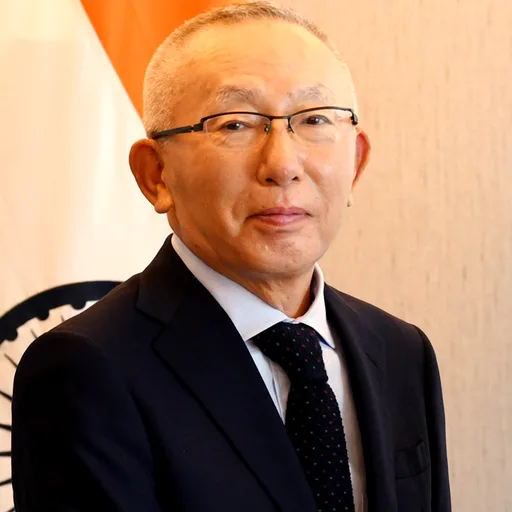
Tadashi Yanai
Japan 1949-02-07
20th-21st century Japanese apparel entrepreneur
Built Uniqlo into a global fast-fashion powerhouse through the SPA model
The 'one win, nine losses' ethos is a precursor to lean-startup pivot culture
Born in Yamaguchi Prefecture, Japan, in 1949, Tadashi Yanai took over his father's small menswear shop and built Fast Retailing, centered on the Uniqlo casual-wear brand, into Japan's largest apparel company. His motto 'one win, nine losses' reflects a philosophy of learning relentlessly from failure. With an estimated fortune of $50.3 billion as of 2025, he is Japan's wealthiest individual. Through rigorous execution of the SPA (Specialty store retailer of Private label Apparel) model, he has redefined the global fast-fashion market.
What You Can Learn
Yanai's management offers wide-ranging lessons for today's entrepreneurs. First, the distribution revolution enabled by the SPA model: by managing everything from planning to retail, he eliminated intermediary costs while controlling quality and price. This model is essentially the structural foundation of the modern D2C brand, and Yanai was the pioneer who executed it at mass-production scale. Second, his system for converting failure into organizational learning: the 'one win, nine losses' ethos aligns with the pivot culture of lean startups. What matters is not the failure itself but what is learned from it and how that learning shapes the next action. Third, the strategic innovation of using material development as an apparel differentiator: HeatTech and AIRism emerged from collaboration with Toray, and this material-driven product development upended the conventions of the apparel industry. The fusion of technology and fashion is expected to accelerate further, and Yanai's approach anticipates that trajectory.
Words That Resonate
Face reality squarely and start from there. That is the foundation of management.
現実を直視して、そこから出発する。それが経営の基本です。
If you don't change, you simply die.
変わらなければ、死ぬだけだ。
One win, nine losses.
一勝九敗
Management is a battle with contradiction.
経営とは矛盾との戦いです。
Life & Legacy
Tadashi Yanai is the entrepreneur who transformed a provincial menswear shop into a global apparel company, remaking the clothing industry not with cheapness but with rationality as his weapon. His management is animated by a distinctive philosophy that treats failure as the wellspring of organizational learning.
Born in 1949 in Ube, Yamaguchi Prefecture, Yanai graduated from Waseda University's School of Political Science and Economics and briefly joined JUSCO (now AEON), leaving after nine months. He then entered his father's company, Ogori Shoji, inheriting a small menswear retail operation. At that point nothing foreshadowed a future global enterprise.
The turning point came in 1984 with the opening of the first 'Uniqlo' store in Hiroshima. The name — a contraction of 'Unique Clothing Warehouse' — signaled a new format: casual apparel sold at low prices in a spacious, warehouse-style setting. Yanai had identified a structural problem: Japan's apparel distribution system was burdened by multiple layers of intermediaries, making it deeply inefficient.
His answer was a thorough implementation of the SPA (Specialty store retailer of Private label Apparel) model. By managing planning, materials procurement, production, logistics, and retail under one roof, he eliminated middleman margins and lowered prices while maintaining quality. Particularly important was the cultivation of tight relationships with partner factories in China and the establishment of rigorous quality-control systems. The 1998 fleece boom, coinciding with the opening of a Harajuku store, catapulted Uniqlo into a national brand: a fleece jacket priced at 1,900 yen sold roughly 26 million units in a single year.
Yanai's path, however, has been far from uninterrupted success. As his phrase 'one win, nine losses' suggests, he has experienced many business failures. A 2001 push into the UK market ended with mass store closures after over-rapid expansion; a food venture called SKIP and a produce-delivery service called FR Foods were both shuttered quickly. Yanai's response has been explicit: 'Don't hide failures — share them across the organization so the same mistake is never repeated.'
From the late 2000s onward, globalization accelerated in earnest. Stores spread across China, South Korea, Southeast Asia, and Western markets, and Fast Retailing took its place alongside Inditex (Zara) and Hennes & Mauritz (H&M) as one of the world's three largest fast-fashion companies. Yanai, however, repeatedly insists that 'Uniqlo is not fast fashion.' Rather than chasing trends with disposable clothing, he aims under the concept of 'LifeWear' — the ultimate everyday clothing — to produce garments that combine functionality with timelessness. The development of functional materials such as HeatTech and AIRism was achieved through a strategic alliance with Toray Industries; the approach of making material innovation the differentiator in apparel has become a hallmark of Uniqlo's identity.
Yanai's management style leans heavily toward top-down decision-making, prioritizing speed. Succession planning has been a longstanding challenge, with multiple CEO changes over the years. As of 2025 Yanai serves as chairman and president of Fast Retailing, with an estimated fortune of approximately $50.3 billion, making him Japan's wealthiest person.
Through the Yanai Tadashi Foundation he is also active in education, notably a scholarship program supporting Japanese students studying abroad. His ongoing drive to challenge global markets from a provincial starting point embodies the possibilities of a Japan-born global entrepreneur.
Expert Perspective
Among entrepreneurial archetypes, Yanai is classified as a distribution-innovating SPA entrepreneur. Where Amancio Ortega of Zara made speed-to-trend his competitive weapon, Yanai carved out the market for basic apparel built around functionality and timelessness. His application of Japanese manufacturing's quality-control philosophy to the apparel domain gives his management a kinship with Toyota's kaizen approach. Succession planning remains an ongoing challenge, making him an embodiment of the universal governance question facing founder-dependent global companies.