Entrepreneurs / Tech
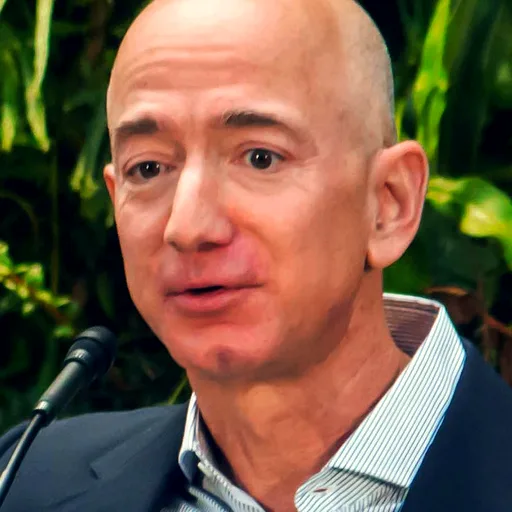
Jeff Bezos
United States 1964-01-12
20th-century American technology entrepreneur
Founded Amazon and reshaped industry structures through e-commerce and cloud computing
The Regret Minimization Framework is a compass for irreversible decisions
Born in New Mexico in 1964, Jeff Bezos left Wall Street to found Amazon as an online bookstore in 1994. Guided by 'customer obsession' and the 'Day 1' philosophy, he reshaped industry structures across e-commerce, cloud computing (AWS), and logistics. His ventures extend well beyond retail to include Blue Origin in space exploration and the acquisition of The Washington Post.
What You Can Learn
The most practical takeaway from Bezos's philosophy for today's business professionals is the 'Regret Minimization Framework' for making high-stakes, irreversible decisions — career changes, founding a company, major investments. By measuring long-term psychological cost rather than short-term risk, one can counter excessive caution. The 'Day 1' concept is equally scalable: over-reliance on process, insensitivity to external trends, and sluggish decision-making are all 'Day 2 symptoms' recognizable in organizations of any size. Periodically asking whether one's organization is still on Day 1 is a powerful preventive against bureaucratization. 'Working Backwards' can also be repurposed for individual career planning: designing actions from the value the market demands leads to skill development that produces tangible outcomes.
Words That Resonate
If you double the number of experiments you do per year you're going to double your inventiveness.
There are two kinds of companies: those that work to try to charge more and those that work to charge less. We will be the second.
Your brand is what other people say about you when you're not in the room.
I knew that if I failed I wouldn't regret that, but I knew the one thing I might regret is not trying.
If you're competitor-focused, you have to wait until there is a competitor doing something. Being customer-focused allows you to be more pioneering.
Day 2 is stasis. Followed by irrelevance. Followed by excruciating, painful decline. Followed by death. And that is why it is always Day 1.
We've had three big ideas at Amazon that we've stuck with for 18 years, and they're the reason we're successful: Put the customer first. Invent. And be patient.
Life & Legacy
Jeff Bezos's place in business history rests not merely on growing an online bookstore into a colossus. What he proved is that a deceptively simple principle — obsession with the customer — can, when embedded as the decision-making foundation of an entire organization for more than a quarter century, simultaneously transform multiple unrelated industries.
Born in Albuquerque and raised in Houston and Miami, Bezos reportedly showed intense interest in science and technology from an early age. He later said that summers spent on his grandfather Lawrence Preston Gise's ranch instilled the self-reliant, fix-it-yourself attitude that shaped his approach to problem-solving. An outstanding student — he won the Silver Knight Award in high school — Bezos studied electrical engineering and computer science at Princeton, graduating in 1986. He joined D.E. Shaw on Wall Street and was promoted to the youngest senior vice president in the firm's history.
In 1994 Bezos made the decision to leave a lucrative career. The thinking tool he employed was the 'Regret Minimization Framework': at 80, would he regret not having seized the explosive growth of the internet? The answer was obvious. He and his then-wife MacKenzie drove to Seattle, drafting the business plan en route, and launched Amazon from a garage. He chose books because they offered manageable inventory and an enormous catalog. In the first year orders far exceeded projections, and Bezos famously packed boxes himself.
Two pillars support Amazon's growth philosophy. The first is 'Working Backwards': every new project begins with a draft press release, and if the value to the customer cannot be articulated clearly, the project does not proceed. The second is 'Day 1' thinking. In his annual shareholder letters Bezos repeatedly stressed the importance of maintaining the startup mentality. Day 2 is stasis, then irrelevance, then decline, then death — therefore it must always be Day 1. These two principles served as the consistent decision criteria as Amazon expanded from book sales into marketplace, digital content, devices, and advertising.
AWS (Amazon Web Services), launched in 2006, epitomizes Bezos's strategic imagination. The idea of opening the technical infrastructure built for Amazon's own e-commerce operation to outside customers defied retail-industry convention. By the 2020s AWS was generating over half of Amazon's operating profit and had played a defining role in establishing cloud computing as an industry category.
In 2013 Bezos personally acquired The Washington Post for $250 million and set about revitalizing the newspaper with technology. Blue Origin, the space-development company he founded in 2000, develops reusable rocket technology, and in 2021 Bezos himself flew a suborbital mission.
In July 2021 Bezos stepped down as CEO, handing the role to Andy Jassy and becoming executive chairman. He has signaled a focus on long-term vision, and his investment in Altos Labs has drawn attention to his interest in life sciences. By prioritizing long-term customer value over short-term profit and embedding a culture that tolerates failure, Bezos has set a benchmark for technology-company management.
Expert Perspective
Among entrepreneurs, Bezos is the most successful practitioner of platform-model entrepreneurship. Where Carnegie and Rockefeller dominated industries through vertical integration, Bezos built horizontal infrastructure — marketplace, AWS, logistics network — on which others run their businesses, creating an ecosystem. This shift has directly influenced Jack Ma's Alibaba and subsequent platform companies as the defining entrepreneurial model of the digital age. His unwavering commitment to long-term investment and his ability to persuade shareholders to accept short-term profit sacrifice are among the most instructive capabilities for any modern entrepreneur.