Artists / Sculpture
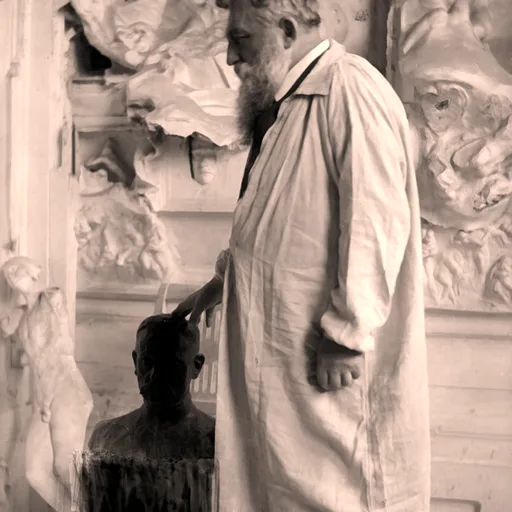
Auguste Rodin
France 1840-11-12 ~ 1917-11-17
French sculptor born in Paris in 1840, regarded as the father of modern sculpture
Created The Thinker and The Kiss, breaking with academic convention by embracing raw surface and the fragment
His insistence on emotional truth over formal perfection opened the door to all of modern sculpture
Born in Paris in 1840, Rodin is regarded as the father of modern sculpture. The Thinker and The Kiss broke with academic convention through raw emotion and unfinished surfaces.
What You Can Learn
Rodin offers enduring lessons. His three failures at the Beaux-Arts exam show that rejection by gatekeepers need not define a career. His embrace of the fragment, letting incomplete work stand as expressive, anticipates the lean-startup principle of shipping an MVP. And his lifelong reworking of The Gates of Hell demonstrates that a single ambitious project can generate a stream of derivative innovations, a pattern familiar in platform-based business models.
Words That Resonate
I invent nothing; I rediscover.
Rien n'est laid dans la nature, il n'y a que la laideur dans l'imitation.
Nothing is a waste of time if you use the experience wisely.
Je choisis un bloc de marbre et j'en coupe tout ce qui n'est pas nécessaire.
The main thing is to be moved, to love, to hope, to tremble.
L'artiste est celui qui voit ce que les autres ne voient pas.
Life & Legacy
Auguste Rodin earned the title father of modern sculpture because he shattered academic convention by treating the sculpted surface as an expressive medium in its own right. Where his predecessors polished marble to flawless smoothness, Rodin left tool marks visible, animated surfaces with rough texture, and let fragments stand as complete works, opening the door to everything from Brancusi to contemporary installation art.
Born November 12, 1840, in Paris to a working-class family, he failed the entrance exam to the Ecole des Beaux-Arts three times. He spent years as a decorative craftsman, absorbing technique while developing outside the academic establishment.
A trip to Italy in 1875 brought him face to face with Michelangelo's unfinished sculptures, whose figures emerging from raw stone became a lifelong inspiration. His first major work, The Age of Bronze (1877), was so realistic that critics accused him of casting from a living model.
The Gates of Hell, commissioned in 1880 and never completed, became a lifelong project from which many of his most famous figures emerged. The Kiss grew from a pair of damned lovers into one of the most reproduced sculptures in history.
Rodin's treatment of the partial figure was revolutionary. This idea liberated sculpture from the obligation to depict whole, idealized forms.
His relationship with Camille Claudel, both his student and his lover, produced a decade of creative exchange and ended in painful separation. His monument to Balzac, a rough-hewn block suggesting the writer's creative force, was rejected at first but is now seen as a milestone in the move toward abstraction.
He died November 17, 1917, at seventy-seven. His insistence on emotional truth over formal perfection directly influenced Brancusi, Giacometti, and Henry Moore.
Expert Perspective
Rodin is the father of modern sculpture, having broken with academic smoothness by treating surface texture and the fragment as expressive tools. The Thinker and The Kiss emerged from The Gates of Hell as independent icons. His partial figures liberated sculpture from the obligation to depict complete forms. His influence runs through Brancusi, Giacometti, and Moore.