Scientists / Physics
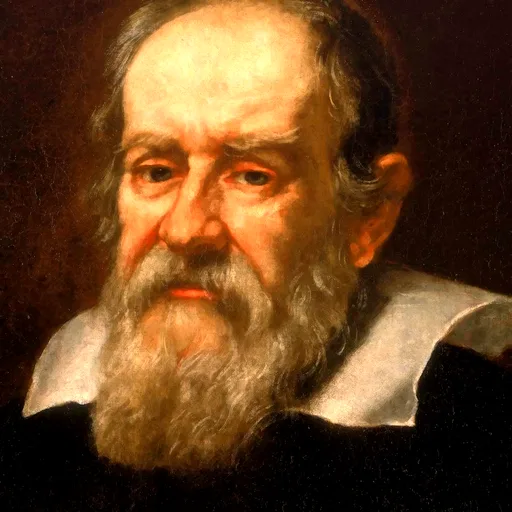
Galileo Galilei
Italy 1564-02-25 ~ 1642-01-08
Sixteenth-century Italian natural philosopher and astronomer
Established modern scientific methodology through telescopic observation and experiments on falling bodies
A model of scientific integrity who confronted authority with observed fact at the cost of condemnation
Italian natural philosopher born in 1564. His telescopic discoveries and falling-body experiments replaced Aristotelian speculation with observation and mathematical formulation.
What You Can Learn
Galileo's insistence on measurement and mathematical formulation is the founding principle of data science and business intelligence. His improvement of the Dutch spyglass into a research telescope illustrates how adapting existing technology for new purposes drives breakthrough results. And his willingness to present observational evidence against established consensus sets a standard for intellectual honesty when the data contradicts organizational assumptions.
Words That Resonate
Mathematics is the alphabet in which God has written the universe.
La matematica è l'alfabeto nel quale Dio ha scritto l'universo.
All truths are easy to understand once they are discovered; the point is to discover them.
In questions of science, the authority of a thousand is not worth the humble reasoning of a single individual.
Measure what is measurable, and make measurable what is not so.
Life & Legacy
Galileo Galilei's enduring contribution is not any single discovery but the transformation of how nature is investigated. Where earlier philosophy rested on Aristotelian authority, Galileo practiced observation, experiment, and mathematical formulation, the cycle that defines modern science.
Born in 1564 in Pisa to the musician Vincenzo Galilei, he enrolled to study medicine but was captivated by Euclid and Archimedes. Early work on specific gravity won him a mathematics lectureship at Pisa in 1589.
In 1609 he built a telescope of roughly twenty-fold magnification and aimed it skyward. Four moons orbiting Jupiter proved that not everything revolves around Earth. Craters on the Moon refuted the Aristotelian doctrine of perfect celestial spheres. Published in Sidereus Nuncius (1610), these findings brought immediate renown.
In mechanics, he rolled balls down inclined planes and showed that falling distance grows with the square of elapsed time, disproving the claim that heavier objects fall faster. He also articulated a nascent concept of inertia: without external force, a body moves uniformly.
The Inquisition trial of 1633 is the most dramatic chapter. His Dialogue defending the Copernican model drew heresy charges; he was convicted and forced to recant. The legend that he whispered "And yet it moves" is almost certainly later fiction. Under house arrest he wrote Two New Sciences, his masterwork on mechanics, published in the Netherlands in 1638.
Galileo's legacy is twofold: he demonstrated that nature's laws are written in mathematics, and he modeled the courage to oppose authority with observed fact. Students Torricelli and Viviani carried his methods forward. He died in 1642 at Arcetri; that year Newton was born in England. The Church acknowledged the error of his condemnation only in 1992.
Expert Perspective
Among scientists, Galileo is the pioneer who replaced Aristotelian speculation with experimental and mathematical method. He contributed foundational work in both astronomy and mechanics and provided observational evidence for Copernicus's heliocentric theory. By laying the methodological groundwork that Newton later built upon, Galileo forms an indispensable link in the Scientific Revolution.