Artists / Baroque
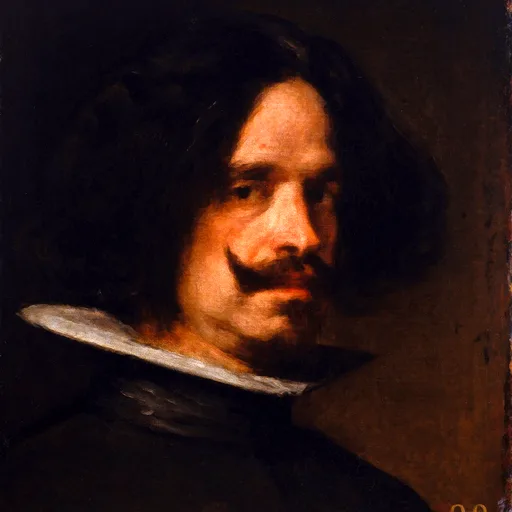
Diego Velázquez
Spain 1599-06-06 ~ 1660-08-06
Spanish court painter born in Seville in 1599
Created Las Meninas, a self-referential masterpiece captivating thinkers for centuries
His equal treatment of kings and jesters and his free brushwork anticipate humanism and Impressionism
Born in Seville in 1599, Velazquez served Philip IV for four decades. Las Meninas has fascinated thinkers for centuries; Manet called him the painter of painters.
What You Can Learn
Velazquez's art yields deep lessons. His equal attention to kings and jesters models a professionalism treating every stakeholder with the same care regardless of status. Las Meninas, which makes painting its own subject, prefigures meta-marketing: turning your process into content. And his ability to innovate within court constraints shows how institutional creators can push boundaries without abandoning their organizational context, a balance relevant to corporate innovators.
Words That Resonate
Truth, not appearance.
La verdad, no la apariencia.
I would rather be first to paint ugliness than second to paint beauty.
Prefiero ser el primero en pintar la fealdad que el segundo en pintar la belleza.
The painter of painters.
Il pittore dei pittori.
Life & Legacy
Diego Velazquez stands apart because, within the closed world of the Spanish Habsburg court, he developed a realism that captures not just appearance but the very atmosphere surrounding a subject. His paintings unite cool observational precision with a poetic spatial quality, a duality that led Edouard Manet to call him the painter of painters.
Born June 6, 1599, in Seville, he entered Francisco Pacheco's workshop as a boy and married his master's daughter in 1618. Early Seville works such as The Water Seller show Caravaggio-influenced chiaroscuro and a dignified treatment of common people that would remain a hallmark.
In 1623 he moved to Madrid and painted Philip IV, who was so impressed that he decreed only Velazquez would paint his portrait. His portraits of marginalized figures stand out for depicting them without mockery or pity, granting them full human dignity.
Two Italian trips shaped his mature style decisively. The first, from 1629 to 1630, introduced him to Venetian color. The second, from 1649 to 1651, produced the portrait of Pope Innocent X, whose unflinching rendition of red vestments and stern expression has been called the most truthful portrait ever painted.
Las Meninas, painted in 1656, is one of the most analyzed works in all of art history. The canvas shows the painter at his easel, the Infanta Margarita and her attendants in the foreground, and the king and queen reflected in a background mirror. Michel Foucault opened The Order of Things with an analysis of this work as a meditation on representation itself.
His late brushwork grew increasingly free; strokes that look rough close up resolve into texture at a distance, anticipating Impressionism by two hundred years. A red cross was later painted onto his self-portrait in Las Meninas, inscribing his social aspiration directly into his greatest work.
Expert Perspective
Velazquez is the defining court painter of the Spanish Golden Age, achieving revolutionary realism and spatial expression. He absorbed Caravaggio's chiaroscuro early and integrated Venetian color through Italian travel. The self-referential Las Meninas pioneered the thematization of representation. His free late brushwork anticipates Impressionism; Manet's epithet painter of painters cemented his stature.