Artists / Sculpture
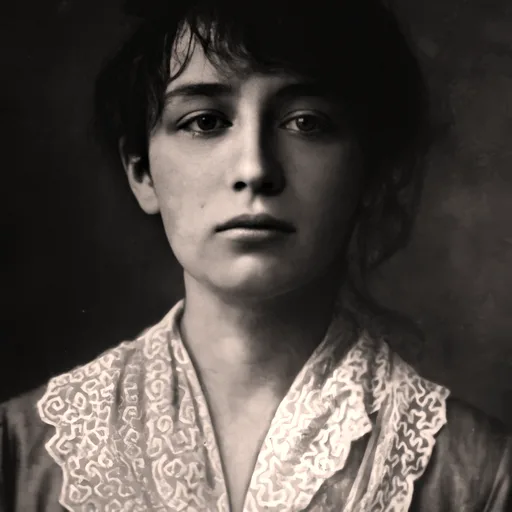
Camille Claudel
France 1864-12-08 ~ 1943-10-19
French sculptor born in 1864, a major artist in her own right beyond her association with Rodin
Created The Waltz and The Age of Maturity, works of intense emotion and technical command
Her posthumous rediscovery affirms that genuine originality endures regardless of the circumstances that once suppressed it
Born in 1864 in northern France, Claudel was a sculptor of fierce originality who studied under Rodin. Works like The Waltz and The Age of Maturity stand on their own merit.
What You Can Learn
Claudel's trajectory offers sobering and inspiring lessons. Her ability to produce masterworks while overshadowed by a dominant mentor shows that creative independence is possible even within an unequal power dynamic. The destruction of her own works warns of the cost of perfectionism and self-doubt. And her posthumous rediscovery affirms that quality endures: work of genuine originality will eventually find its audience regardless of the circumstances that suppressed it.
Words That Resonate
I have been able to find all the elements of art in nature.
Il y a toujours quelque chose d'absent qui me tourmente.
It is not the model who must inspire the artist, but the artist who must bring the model to life.
Mon rêve serait de ne plus entendre parler de Monsieur Rodin.
Sculpture is the art of the hole and the lump.
Je suis tombée dans le gouffre. Je vis dans un monde si curieux, si étrange.
Life & Legacy
Camille Claudel deserves attention not merely as Rodin's student and lover but as a sculptor of independent, fierce originality whose emotional intensity and technical command place her among the most important artists of her generation.
Born December 8, 1864, in Fere-en-Tardenois to a civil servant, she showed sculptural talent early and moved to Paris to study at the Academie Colarossi, since the Beaux-Arts did not admit women. In 1884 she entered Rodin's studio as an assistant and soon became his collaborator and lover.
Her contributions to Rodin's workshop included modeling hands and feet for major commissions, but her independent works distinguish her clearly. The Waltz captures a couple mid-turn in a spiraling embrace, its sinuous movement rivaling anything Rodin produced. Sakuntala (or Vertumnus and Pomona) fuses two figures into a single block of passionate tenderness.
The Age of Maturity (1899) is widely read as an allegory of her relationship with Rodin: a young woman reaches for a man who is being led away by an older figure. Its emotional rawness and compositional daring mark it as one of the most powerful sculptures of the late 19th century.
From the late 1890s her mental health declined. She grew increasingly paranoid, destroyed many of her own works, and in 1913 was committed to a psychiatric institution by her family, where she remained for thirty years until her death on October 19, 1943, at seventy-eight. Whether her confinement was medically necessary or a patriarchal response to a difficult woman remains debated.
Her posthumous rediscovery, accelerated by Anne Delbee's biography and films starring Isabelle Adjani and Juliette Binoche, has restored her standing as a major sculptor whose work transcends the biographical narrative that long overshadowed it.
Expert Perspective
Claudel is a sculptor of fierce originality whose emotionally charged works stand independently of her relationship with Rodin. The Waltz and The Age of Maturity display a command of movement and psychological intensity that place her among the leading sculptors of the late 19th century. Her posthumous rediscovery has underscored the importance of re-evaluating artists historically marginalized by gender and biography.