Artists / Baroque
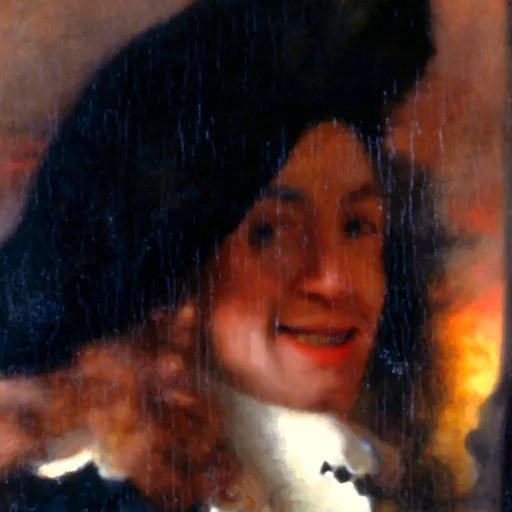
Johannes Vermeer
Netherlands 1632-10-01 ~ 1675-01-01
Dutch painter born in Delft in 1632, known as the master of light
Created Girl with a Pearl Earring and The Milkmaid, freezing everyday moments in luminous stillness
His extreme rarity, barely three dozen works, paradoxically made him one of the most treasured Old Masters
Born in 1632 in Delft, Vermeer secured an enduring place in art with barely three dozen paintings. Girl with a Pearl Earring and The Milkmaid capture natural light so precisely that fleeting moments feel eternal.
What You Can Learn
Vermeer's art holds clear lessons for today's professionals. His commitment to quality over quantity, producing only two or three paintings a year, shows how a small body of superb work can outlast mass output by centuries. His eye for beauty in the mundane, a woman pouring milk, a letter being read, parallels the business skill of spotting untapped value in everyday processes. And the rarity of his oeuvre inadvertently demonstrates how scarcity elevates market value, a principle central to brand strategy.
Words That Resonate
The painter paints not what he sees but what he will see.
De schilder schildert niet wat hij ziet, maar wat hij zal zien.
Simplicity is the ultimate sophistication in rendering light.
Light is the sovereign remedy to which all the rules of art must submit.
Life & Legacy
Johannes Vermeer matters so much despite so few paintings because in his treatment of light and spatial composition he reached a level that later painters have rarely matched. His interiors depict everyday acts, reading a letter, pouring milk, yet the stillness created by window light filling a room feels like a moment frozen for all time.
Born in October 1632 in Delft to a silk-worker and art dealer, he grew up surrounded by paintings. In 1653 he married Catharina Bolnes and joined the Guild of Saint Luke as a master painter. Who taught him remains unknown; Karel Fabritius is a candidate but proof is lacking, and this gap has earned him the nickname the Sphinx of Delft.
Early works such as Christ in the House of Martha and Mary are narrative scenes, but from around 1656 he shifted to genre painting. Nearly all subsequent works show one or two figures in a domestic interior lit from the left. Subjects are quiet: a woman reading, playing music, weighing gold. Yet his rendering of light, geometry, and color elevates the ordinary into lasting beauty.
His most distinctive technique was the lavish use of ultramarine made from lapis lazuli, then as costly as gold. He applied it not only to blue passages but as an underlying tone, giving his surfaces a cool luminosity. Whether he used a camera obscura remains debated; halation effects and precise perspective hint at optical aids, but no direct evidence has surfaced.
The French invasion of 1672 devastated the Dutch economy. As painter and dealer Vermeer could no longer sell, and with fifteen children to support his finances collapsed. His wife later testified that worry ruined his health; he died on December 15, 1675, at forty-three. His name sank into obscurity for nearly two centuries until the French scholar Thore-Burger published the first serious study in 1866. Today he is among the most beloved Old Masters.
Expert Perspective
Vermeer reached an unmatched peak of light and spatial expression within the Dutch Golden Age. Where Rembrandt used dramatic chiaroscuro to illuminate inner life, Vermeer employed the quiet diffusion of natural window light to transform everyday spaces into timeless moments. His bold use of ultramarine and the pointille technique for rendering light particles are technically original, and the possible use of the camera obscura makes him a precursor to exploring the relationship between perception and representation.