Scientists / Biology & Medicine
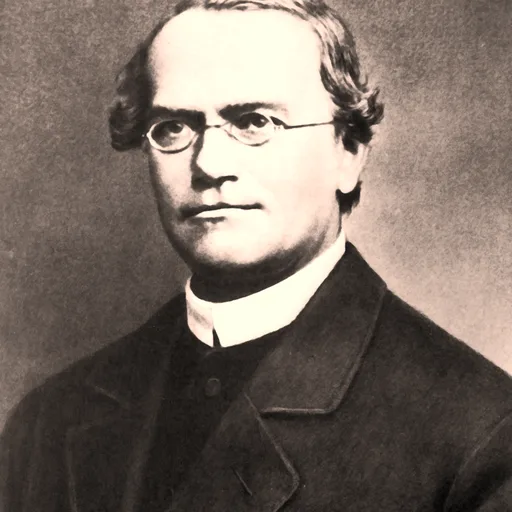
Gregor Mendel
Czech Republic 1822-07-20 ~ 1884-01-06
Nineteenth-century Augustinian friar and biologist from the Austrian Empire
Discovered the three laws of heredity through systematic pea-plant experiments
Ignored in life, rediscovered after death, his work became the bedrock of modern genetics
Augustinian friar born in 1822 who discovered heredity's laws through pea-plant experiments. Ignored in life, his work was rediscovered in 1900 as the foundation of genetics.
What You Can Learn
Mendel's story illustrates the long-term value of basic research: work ignored in its time can later reshape entire industries, a lesson for R&D budgets tempted to cut projects lacking immediate payoff. His 29,000-plant dataset is a precursor of modern A/B testing: statistically rigorous samples yield robust conclusions. And his fusion of mathematics with biology anticipates breakthroughs that arise when methods from one field enter another.
Words That Resonate
My time will surely come.
Meine Zeit wird schon kommen.
The experiments proceed slowly. At first a certain amount of patience was needed, but I soon found that matters went better when I carried on several experiments simultaneously.
The value and utility of any experiment are determined by the fitness of the material to the purpose for which it is used.
Life & Legacy
Gregor Mendel derived the mathematical laws governing heredity from methodical pea-plant experiments in a monastery garden. His discovery was virtually ignored during his lifetime, but when three botanists independently rediscovered his work in 1900, it launched the science of genetics and ultimately merged with Darwin's evolution theory to form the Modern Synthesis.
Born in 1822 in a Moravian farming village, Mendel entered the Augustinian monastery at Brno in 1843, gaining access to a scholarly community of philosophers, mathematicians, and botanists. After failing a teaching-certification exam, he studied physics under Christian Doppler and botany under Franz Unger at the University of Vienna. Doppler's emphasis on experimental and mathematical method directly shaped his later research design.
From 1856 to 1863 Mendel cultivated roughly 29,000 pea plants, crossing them for seven contrasting traits such as seed shape, seed color, and flower color. He recorded trait ratios with statistical precision rare in biology, discovering a consistent 3:1 dominant-to-recessive ratio.
From these results he inferred three laws: dominance, segregation, and independent assortment. Together they established that heredity is transmitted not by blending but by discrete particles, the concept later identified as genes.
His 1865 presentation and 1866 publication drew almost no response. The biological community, committed to blending inheritance, could not absorb a statistical model of discrete factors. In 1868 Mendel became abbot and was consumed by administrative duties. He died of kidney disease in 1884 with his scientific contribution largely unknown.
In 1900 de Vries, Correns, and Tschermak independently confirmed his laws, and his foresight was finally recognized. Everything from DNA to genome editing rests on principles Mendel uncovered in a monastery garden.
Expert Perspective
Among scientists, Mendel is the founder of genetics. Against the prevailing blending-inheritance model, he demonstrated discrete particulate heredity through experimental evidence, a paradigm shift of the first order. His introduction of statistical methods into biology pioneered biostatistics and computational biology. That his work was ignored for thirty-five years is a cautionary tale about how contemporary paradigms can blind a field to fundamental insight.