Artists / Chinese Art
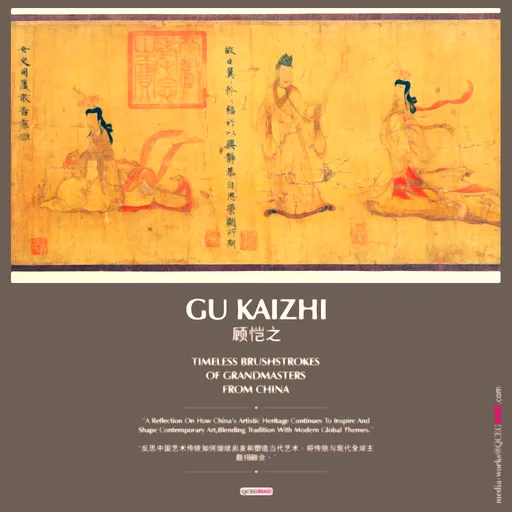
Gu Kaizhi
China 0345-01-01 ~ 0406-01-01
Chinese painter born around 344 AD, revered as the father of Chinese painting
Established the principle that painting should convey inner spirit in the Admonitions Scroll
His idea that art captures spirit rather than appearance remains foundational to East Asian aesthetics and anticipates modern UX thinking
Born around 344 AD in Jin-dynasty China, Gu Kaizhi is revered as the father of Chinese painting. His Admonitions Scroll established the principle that painting should convey inner spirit, not mere likeness.
What You Can Learn
Gu Kaizhi offers a foundational lesson: substance over surface. His principle that art must capture spirit rather than copy appearance anticipates user-experience design, where how something feels matters more than how it looks. His idea that the eyes reveal inner character maps onto modern advice about authentic communication. And the survival of his influence through copies and quotations, long after originals were lost, shows that ideas endure longer than artifacts.
Words That Resonate
Life & Legacy
Gu Kaizhi is regarded as the founding figure of Chinese painting because he articulated the principle that art should transmit the spirit (chuanshen) of its subject rather than merely copy outward appearance. This idea became the theoretical cornerstone of Chinese aesthetics for the next sixteen centuries.
Born around 344 AD in Wuxi during the Eastern Jin dynasty, he served at the court and was known for his eccentricity as well as his talent. Literary sources describe him as equally accomplished in painting, poetry, and wit, earning the nickname Three Perfections.
His most celebrated surviving work (in copy form) is the Admonitions of the Instructress to the Court Ladies, a handscroll now divided between the British Museum and the Palace Museum in Beijing. The scroll illustrates moral lessons for court women through scenes of elegant restraint. Figures are rendered with fine, flowing lines known as spring-silkworm-spinning-silk brushwork, and their expressions and postures convey character and emotion with remarkable subtlety.
The Nymph of the Luo River, another work surviving in later copies, depicts a prince's encounter with a river goddess in a landscape of misty waters. The composition's integration of figure and landscape was innovative for its time and influenced generations of later painters.
Gu Kaizhi's theoretical writings, though surviving only in fragments quoted by later authors, introduced the concept of capturing the spirit through the eyes of a figure, a principle that became central to Chinese portrait theory. His idea that the eyes are the window to spiritual likeness shaped the entire tradition of Chinese figure painting.
He died around 406 AD. Although no undisputed original paintings survive, the copies and the theoretical legacy ensure his foundational status in Chinese art. His insistence that art aims beyond physical likeness toward spiritual truth influenced not only painting but calligraphy, poetry, and garden design across East Asia.
Expert Perspective
Gu Kaizhi is revered as the father of Chinese painting. His concept of transmitting spirit (chuanshen) became the theoretical foundation of Chinese aesthetics. The Admonitions Scroll, surviving in copies, demonstrates his fine-line brushwork and psychological subtlety. His influence extends across painting, calligraphy, and garden design throughout East Asia.