Artists / Renaissance
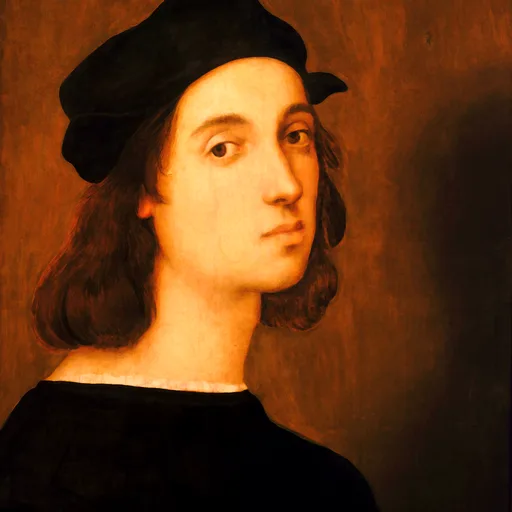
Raphael
Italy
Italian painter and architect of the High Renaissance, born in Urbino in 1483
Created the School of Athens and a series of Madonnas, fusing Leonardo's sfumato with Michelangelo's dynamism
His practice of absorbing the best of rivals and reforging it remains a model for creative leadership
Born in Urbino in 1483, Raphael perfected High Renaissance ideals in thirty-seven years. His School of Athens epitomizes classical harmony, fusing Leonardo and Michelangelo into serene beauty.
What You Can Learn
Raphael's approach holds lessons for today's professionals. His talent for absorbing competitors' strengths and recombining them mirrors competitive analysis: study rivals, then recontextualize their insights. His management of a large workshop executing multiple commissions is an early model of creative-team leadership, balancing delegation with quality control. His synthesis of classical rigor and emotional warmth parallels the design-thinking challenge of uniting function and beauty.
Words That Resonate
Painting is made not to describe truth but to create beauty.
La pittura non è fatta per descrivere la verità ma per creare la bellezza.
To paint a beautiful woman I would need to see many, but since beautiful women are scarce, I make use of a certain idea that comes to my mind.
Per dipingere una bella donna, dovrei vederne molte, ma poiché vi è carestia di belle donne, io mi servo di certa idea che mi viene nella mente.
Every painter paints himself.
Ogni pittore dipinge sé.
Life & Legacy
Raphael Sanzio holds a special place in art history for his gift of absorbing others' breakthroughs and fusing them into harmony. He studied Leonardo's sfumato and Michelangelo's dynamism, yet filtered both through calm clarity, presenting Renaissance beauty in its most accessible form.
Born in 1483 in Urbino to court painter Giovanni Santi, he entered Perugino's workshop after his father's death. By his mid-teens his work was reportedly indistinguishable from the master's.
In 1504 he moved to Florence, where Leonardo and Michelangelo were competing openly. From Leonardo he took tonal transitions and pyramidal composition; from Michelangelo, energetic figure torsion. His Florentine Madonnas place mother and child in triangular arrangements with human warmth previously rare in religious art.
In 1508 Pope Julius II summoned him to Rome to decorate the Stanza della Segnatura. The School of Athens gathers ancient thinkers beneath a grand vault, condensing the ideal of knowledge into one wall. Interlocking gazes and gestures create a flow widely regarded as the apex of Western group composition.
Raphael's hallmark is reconciling opposites: strict perspective with organic placement, idealized beauty with individual likeness, gravity with warmth. His Madonna series explores the mother-child bond through varied designs, infusing sacred subjects with tenderness.
His legacy shaped European academies for centuries. Pupils like Giulio Romano extended Mannerism; Poussin and David carried his composition forward. That the Pre-Raphaelites defined themselves by reaching back before him confirms his watershed status. He died on April 6, 1520, his thirty-seventh birthday, yet his output was immense and his workshop management adds a managerial dimension to his artistry.
Expert Perspective
Raphael is the consummate master of High Renaissance classical beauty. He extended Perugino's soft palette with Leonardo's sfumato and Michelangelo's dynamism, achieving harmonious composition and clear spatial expression. From the School of Athens to intimate Madonnas, he realized universal balance regardless of subject. As the academic standard for centuries, his influence pervades Western art education; the Pre-Raphaelite rebellion itself attests to his role as a dividing line.