Philosophers / Contemporary Western
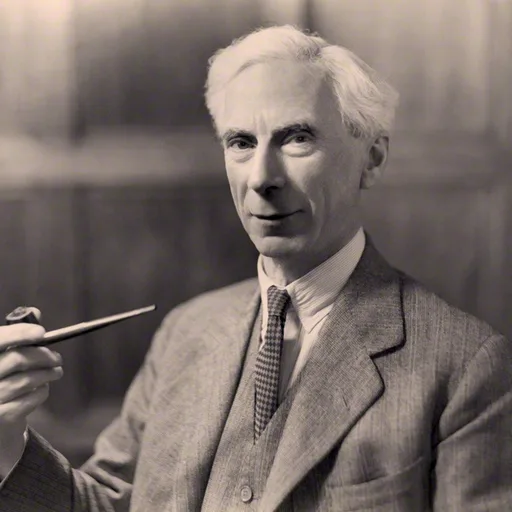
Bertrand Russell
United Kingdom 1872-05-18 ~ 1970-02-02
19th-20th century British philosopher and logician
Attempted to ground mathematics in logic with Principia Mathematica
Decomposing complex problems into their smallest units is the essence of data-driven management
Born in Britain in 1872 into the aristocratic Russell family, Bertrand Russell was a philosopher, logician, and mathematician. In the monumental Principia Mathematica, co-authored with Whitehead, he attempted to ground all of mathematics in logic and became one of the founders of analytic philosophy. Russell's Paradox revolutionized set theory; he advanced logical atomism as a philosophical method. He was also a committed anti-war and nuclear-disarmament activist. He received the Nobel Prize in Literature in 1950 and sustained his intellectual combat until his death at 97.
What You Can Learn
Russell's thought provides practical guidance for a modern world awash in information and riven by division. His lifelong commitment to 'thinking with logical clarity' is an indispensable foundation for individual decision-making in an era of emotional arguments and misinformation on social media. In business, the logical-atomist approach of decomposing complex management challenges into the smallest unit of fact and building upward from there mirrors the essence of data-driven management. His insight that 'the stupid are cocksure while the intelligent are full of doubt' is a corrective against confirmation bias in investment decisions and strategic planning. From a self-development perspective, his maintenance of intellectual curiosity until the age of 97 and his work across philosophy, mathematics, politics, and education make him a pioneering model of the T-shaped professional and portfolio career. His ideal of 'a life inspired by love and guided by knowledge' poses a fundamental question about what genuine richness means in an efficiency-obsessed age.
Words That Resonate
Three passions, simple but overwhelmingly strong, have governed my life: the longing for love, the search for knowledge, and unbearable pity for the suffering of mankind.
Neither a man nor a crowd nor a nation can be trusted to act humanely or to think sanely under the influence of a great fear.
The good life is one inspired by love and guided by knowledge.
Do not fear to be eccentric in opinion, for every opinion now accepted was once eccentric.
The fundamental cause of the trouble is that in the modern world the stupid are cocksure while the intelligent are full of doubt.
Life & Legacy
Bertrand Russell redefined the boundary between logic and philosophy and fundamentally reshaped the intellectual landscape of the 20th century. Mathematician, philosopher, social critic, peace activist — he wore many hats, but a single conviction ran through them all: 'clear thinking is humanity's most powerful weapon.' His life, spanning 98 years, is a record of an indomitable quest to comprehend the world through the power of logic.
Born in 1872 into the distinguished Russell earldom, he was a grandson of Lord John Russell, who served twice as Prime Minister, and his godfather was the great utilitarian philosopher John Stuart Mill. Yet he lost both parents in early childhood and endured a solitary boyhood under the care of a strict grandmother. That solitude drove him into the world of mathematics. At eleven, when his brother introduced him to Euclidean geometry, Russell later recalled the experience as 'beautiful as first love.' The discovery that truth could be reached through proof set the course of his life. He entered Trinity College, Cambridge, graduating in 1893, where he met G.E. Moore and A.N. Whitehead and found intellectual allies for his revolt against the British Idealism then dominant.
Russell's scholarly career turned on two pivots. The first was his discovery in 1901 of Russell's Paradox — 'Does the set of all sets that do not contain themselves contain itself?' — which exposed a fatal contradiction in Frege's naive set theory and triggered a seismic shift in the foundations of mathematics. The second was the three-volume Principia Mathematica, co-authored with Whitehead over roughly a decade, which attempted to derive all of mathematics from logic alone. This grand logicist project was later shown to have principled limits by Goedel's incompleteness theorems, but it propelled the explosive development of symbolic logic and the birth of analytic philosophy.
Russell's philosophical method crystallized as logical atomism: the world is composed of irreducible atomic facts, and language reflects the structure of those facts. This approach swept away the ambiguities of ordinary language and transformed philosophy into a discipline of rigorous logical analysis. His 1905 paper 'On Denoting,' which elucidated the logical structure of definite descriptions and showed how statements about non-existent objects can be meaningful, remains a model of analytic philosophy more than a century later. His student Wittgenstein grew from the soil of Russell's logicism and went on, in the Tractatus Logico-Philosophicus, to challenge his teacher's framework at its foundations. Russell carried the tools of logical analysis into epistemology, metaphysics, ethics, education theory, and the critique of religion, renewing the very meaning of the philosophical enterprise.
Parallel to his academic work, Russell never ceased speaking to society. During World War I he publicly opposed the war, was imprisoned for it, and lost his Cambridge lectureship. He continued writing from his cell — an embodiment of the intellectual's social responsibility. In 1920 he visited Soviet Russia and China, observing revolutionary regimes with a cool eye. After World War II he led the campaign for nuclear disarmament, co-authoring the Russell-Einstein Manifesto in 1955 to warn of the threat of nuclear war. In his final years he mounted a sharp critique of the Vietnam War and organized a civilian war-crimes tribunal with Sartre. The Nobel Prize in Literature, awarded in 1950, honored both the distinction of his philosophical prose and his humanitarian ideals.
Married four times — the last at the age of eighty — Russell never lost his appetite for logical clarity or his passion for social justice until his death in 1970 at the age of 97. He was a figure who answered, with his own life, the question of how an intellectual should engage with society.
Expert Perspective
In the history of Western philosophy, Russell is positioned alongside Frege as a co-founder of analytic philosophy. While Continental philosophy turned toward phenomenology and existentialism, Russell placed logic at the foundation of philosophy and set the direction of the Anglo-American philosophical tradition. In epistemology he stood in the empiricist lineage while emphasizing logical construction; in metaphysics he developed a pluralistic cosmology from a realist standpoint. In ethics he showed utilitarian tendencies but characteristically privileged social practice over the construction of systematic ethical theory. His influence on subsequent generations — Wittgenstein, Carnap, and others — is immeasurable, and he is rightly regarded as the figure who fixed the coordinates of 20th-century Anglophone philosophy.