Investors / Risk
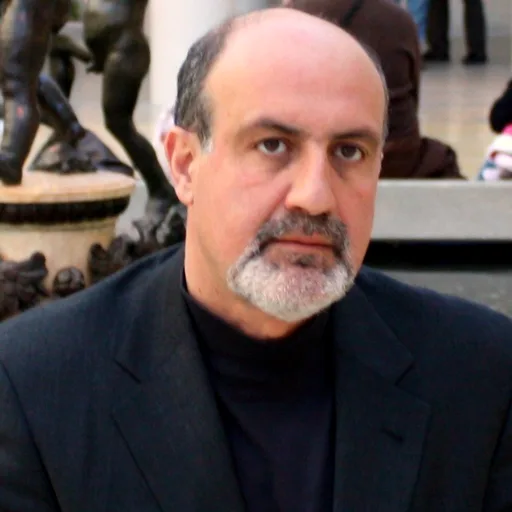
Nassim Nicholas Taleb
United States 1960-09-12
20th-century Lebanese-born risk thinker and former trader
Introduced Black Swan theory and the concept of antifragility
The warning that overconfidence in statistical models is the greatest risk remains as valid as ever
Born in Lebanon in 1960, Nassim Nicholas Taleb transitioned from Wall Street options trader to thinker on uncertainty. He introduced Black Swan theory and the concept of antifragility, exposing humanity's cognitive blind spots regarding unpredictable risk. Having validated his theories during the 2008 financial crisis, he opened new frontiers in the field of risk engineering as a practitioner-intellectual.
What You Can Learn
Taleb's thought offers deep insights for individual investors, particularly those beginning their journey with index funds. Many beginners treat 'long-term, diversified, regular contributions' as an infallible mantra, but Taleb warns that overconfidence in statistical models is itself the greatest risk. The starting point is to internalize — not merely recite — the fact that past returns do not guarantee future performance. Concretely, his 'barbell strategy' is instructive: allocate the bulk of assets to extremely safe instruments and direct a small portion toward high-risk, high-reward opportunities. Rather than taking moderate risk across the board, splitting between the two extremes allows one to survive unpredictable crashes while capturing upside. The lesson of 'skin in the game' also serves as a filter for evaluating investment advice: ask whether the adviser holds the same position and bears the downside risk. In an uncertain world, the key to survival is not improving prediction accuracy but designing a structure that avoids fatal damage when predictions are wrong.
Words That Resonate
Wind extinguishes a candle and energizes fire. Likewise with randomness, uncertainty, chaos: you want to use them, not hide from them.
Don't tell me what you think, tell me what you have in your portfolio.
Suckers try to win arguments, non-suckers try to win.
If you see fraud and do not say fraud, you are a fraud.
The problem with experts is that they do not know what they do not know.
The three most harmful addictions are heroin, carbohydrates, and a monthly salary.
Life & Legacy
Nassim Nicholas Taleb is a rare figure who has confronted uncertainty — humanity's greatest challenge — as both practitioner and philosopher. His central message to the world is a fundamental warning: 'we don't know what we don't know.' That message has sent ripples far beyond financial markets into medicine, politics, technology, and other domains.
Taleb was born in 1960 in Amioun, Lebanon, into a prominent Greek Orthodox family. His father was an oncology researcher; his grandfather and great-grandfather held senior positions in the Lebanese government. Witnessing the unpredictable devastation of the Lebanese Civil War, which began in 1975, is said to have exerted a decisive influence on his intellectual formation. Before the war, Lebanon was known as 'the Paris of the Middle East,' enjoying conspicuous prosperity; its sudden collapse engraved the conviction that 'stability does not last' deep into his psyche. This formative experience became the starting point for his lifelong skepticism of the tame, normally-distributed worldview. After earning a science degree from the University of Paris, he obtained an MBA from the Wharton School of the University of Pennsylvania, equipping himself with both the practice and theory of finance.
In the late 1980s Taleb began his career as an options trader on Wall Street. During the Black Monday crash of 1987, positions betting on extreme downside moves yielded enormous profits. This was not mere luck but a confirmation of his core investment thesis about 'fat tails': extreme events that standard statistical models based on the normal distribution deem virtually impossible in fact occur with striking frequency. Taleb made this divergence his lifelong theme, and through intellectual exchange with mathematician Benoit Mandelbrot he solidified its theoretical foundation.
Taleb's intellectual output crystallized in a five-volume series he titled 'Incerto.' Fooled by Randomness (2001) exposed the cognitive bias of mistaking luck for skill. The Black Swan (2007) systematized the concept of rare, unpredictable, high-impact events; the Sunday Times named it one of the twelve most influential books since World War II. Antifragile (2012) coined the term for the property of gaining from disorder — systems that do not merely resist shocks but grow stronger through adversity — and outlined design principles for building such systems. Skin in the Game (2018) mounted a sharp critique of experts who dispense advice without bearing the consequences of being wrong, arguing that decision-makers must themselves bear the results of their decisions. A companion volume of technical essays provided the mathematical underpinning, making explicit his dual stance as practitioner and theorist.
During the 2008 global financial crisis, Taleb's theories were dramatically vindicated. Universa Investments, where he served as adviser, generated enormous returns in the midst of the crisis, and the market itself proved his critique of prevailing risk-management methods. The epithet 'the emperor of chaos' is said to have taken hold during this period.
Since 2008 Taleb has served as Distinguished Professor of Risk Engineering at New York University's Tandon School of Engineering, remaining active at the intersection of academia and practice. A hallmark of his thought is the fusion of classical wisdom — Seneca and the Stoics — with cutting-edge probability theory. He has also been deeply influenced by the philosopher Karl Popper's falsificationism, constructing a methodology that begins from 'what we cannot know.' Including his acerbic controversies on social media, Taleb as a figure embodies the importance of refusing deference to authority and thinking for oneself.
Expert Perspective
Within the investor genre, Taleb is an extraordinarily unusual figure. Unlike Buffett's value investing or Lynch's growth investing, his philosophy focuses not on 'what will happen' but on 'what could happen.' His obsession with tail risk, fundamental distrust of normal-distribution models, and orientation toward asymmetric bets fit no conventional investor category. By placing risk itself at the center of his philosophy, he expanded the domain of investment thought to the intersection of financial engineering and philosophy.