Entrepreneurs / Retail
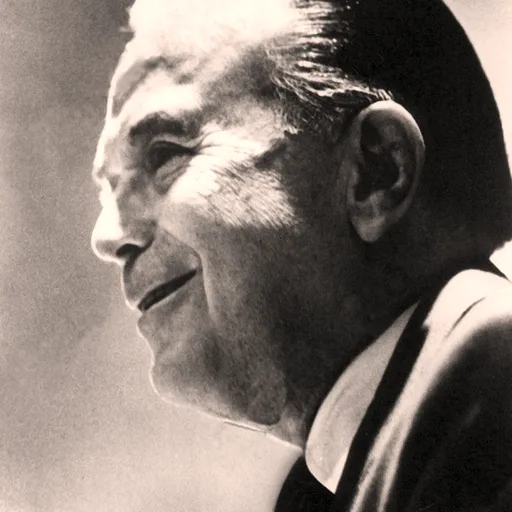
Ray Kroc
United States 1902-10-05 ~ 1984-01-14
20th-century American fast-food industry revolutionary
Built McDonald's into the world's largest restaurant chain through franchising
A 52-year-old's leap is a precedent for career pivots in the era of the hundred-year life
Born in 1902 in Oak Park, a suburb of Chicago. At 52, Ray Kroc encountered the McDonald brothers' hamburger stand, secured the franchise rights, and built a system that standardized Quality, Service, Cleanliness, and Value (QSC&V). He transformed a single regional restaurant into the world's largest fast-food chain. A late bloomer who preached that 'success in business comes down to whether you keep sweating.'
What You Can Learn
Kroc's experience offers three practical lessons for today's entrepreneurs and professionals. First, age is not a barrier. His trajectory of launching at 52 serves as a powerful precedent for anyone contemplating a career pivot in their forties or fifties in an era of hundred-year lifespans. What matters is applying accumulated experience to a new domain: just as Kroc converted his paper-cup sales skills and restaurant-industry knowledge into franchise-building capability, past careers invariably become weapons for the next challenge. Second, the power of systemization and standardization: a business that depends on individual skill does not scale. Kroc's approach — setting QSC&V standards and ensuring reproducibility through manuals and training — is structurally identical to operational templating in modern SaaS and platform businesses. Third, the design of mutual prosperity with partners: the structure that aligned franchisee profits with corporate profits is the prototype of stakeholder design in today's ecosystem-model businesses.
Words That Resonate
Luck is a dividend of sweat. The more you sweat, the luckier you get.
If you work just for money, you'll never make it, but if you love what you're doing and you always put the customer first, success will be yours.
The two most important requirements for major success are: first, being in the right place at the right time, and second, doing something about it.
Press on. Nothing in the world can take the place of persistence.
None of us is as good as all of us.
Life & Legacy
Ray Kroc's story proves that persistence can clear a path regardless of how late the start. He was 52 when he began building McDonald's into a national chain; the first half of his life was a seemingly disconnected sequence of careers — paper-cup salesman, piano player, multi-mixer distributor. Yet Kroc himself later reflected that every one of those experiences cultivated the skills essential to building a franchise business.
Born in 1902 in Oak Park, Illinois, to a family of Czech immigrants, Kroc showed initiative early: during World War I he falsified his age to volunteer as a Red Cross ambulance driver. Walt Disney is said to have served in the same unit. After the war, Kroc spent seventeen years selling paper cups for the Lily-Tulip Cup Company. The face-to-face selling skills honed during that period, and the knowledge of the restaurant industry accumulated by visiting eateries across the country, became the foundation for his later leap.
In 1954 Kroc visited the McDonald brothers' restaurant in San Bernardino, California. He had heard of a shop running eight of the multi-mixers he sold simultaneously and went to see for himself. What he found was a system that standardized cooking processes like a factory assembly line and served a limited menu at astonishing speed. Kroc immediately grasped the franchise potential and signed a deal with the brothers. The following year he opened the first franchise location in Des Plaines, Illinois, and the nationwide expansion of McDonald's began.
The core of Kroc's management philosophy is captured in four letters: QSC&V — Quality, Service, Cleanliness, and Value. To maintain these standards uniformly across every location, he established Hamburger University, a franchise training facility, and developed manuals standardizing everything from cooking procedures to cleaning methods. The innovation was not simply sharing recipes but systematizing the operation of a business so that anyone, anywhere, could deliver the same customer experience. Kroc also insisted that franchisors could not succeed unless their franchisees succeeded, building a model of mutual prosperity.
In 1961 Kroc purchased the McDonald brothers' trademark and full business rights for $2.7 million. The acquisition ended years of tension with the brothers and gave Kroc complete decision-making authority. He then established a real-estate company to secure store locations directly, creating a dual revenue structure of franchise fees and property income that reinforced the company's financial foundation. This real-estate model made McDonald's function not just as a restaurant company but as a real-estate entity, financially underpinning its rapid growth.
Kroc died in 1984 at the age of 81. By then McDonald's had expanded to more than 30 countries. As the title of his autobiography Grinding It Out suggests, the success was not overnight but the accumulation of daily incremental improvement and dogged persistence. He was also active in philanthropy, supporting the founding of Ronald McDonald House, and was involved in professional baseball as owner of the San Diego Padres. A perfectionist who generated friction through his forceful personality — clashing at times with the McDonald brothers and with franchisees — it was precisely that tenacity and obsession with systemization that propelled a small-town hamburger stand into a global brand.
Expert Perspective
Kroc's distinctiveness as an entrepreneur lies not in inventing from scratch but in discovering an excellent existing model and building the system to replicate it nationwide. He was a scaler rather than an inventor, and his achievement in systematizing the franchise format for the food-service industry had a decisive influence on the subsequent franchise expansion of convenience-store chains and service businesses. His late start at 52 is also an instructive example of how accumulated experience and industry knowledge can become the preconditions for explosive growth.