Artists / Baroque
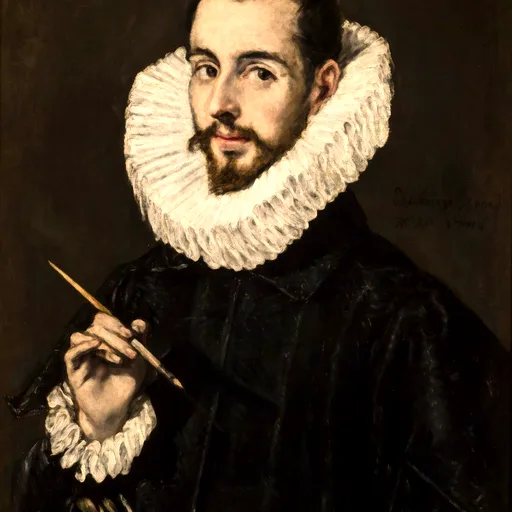
El Greco
Greece 1541-10-01 ~ 1614-04-07
Greek-born painter who settled in Toledo, Spain, born in 1541
Developed elongated figures and ecstatic color in The Burial of the Count of Orgaz
His radical departure from naturalism to convey spiritual intensity models how uncompromising vision eventually finds its audience
Born in Crete in 1541, El Greco developed an intensely personal Mannerist style of elongated figures and ecstatic color in Toledo, Spain. The Burial of the Count of Orgaz fuses earthly and celestial realms.
What You Can Learn
El Greco offers a lesson in conviction. His refusal to conform to prevailing tastes cost him contemporary fame but secured posthumous admiration from modernists who recognized his radical distortion as visionary. His multicultural background, Cretan, Venetian, Roman, Spanish, shows how absorbing multiple traditions can produce something unlike any one of them. And his centuries-long eclipse followed by rediscovery parallels Botticelli's and Vermeer's, affirming that quality outlasts fashion.
Words That Resonate
I would not be content to be considered a mere imitator of nature.
Yo no sería discípulo de Miguel Ángel; pero, si se destruyera toda esta obra, yo la haría con dignidad y decoro.
To paint as I see, not as others wish me to see.
La luz guía a la verdad.
I hold the imitation of color to be the greatest difficulty of art.
El color es más importante que el dibujo.
Life & Legacy
El Greco stands apart because he forged a style so personal that it resisted classification for centuries. His elongated figures, acidic color harmonies, and mystical intensity bewildered contemporaries and later academicians alike, only to be embraced by Expressionists and modernists as prophetic.
Born Domenikos Theotokopoulos in 1541 in Candia, Crete, then part of the Venetian Republic, he trained as an icon painter in the Byzantine tradition. He moved to Venice, where he absorbed Titian's color and Tintoretto's dynamic composition, then to Rome, where he studied Michelangelo.
In 1577 he settled in Toledo, Spain, a city of intense Counter-Reformation piety that matched his own spiritual temperament. The Burial of the Count of Orgaz (1586) is his masterpiece: the lower half depicts the burial attended by solemn Toledan nobles rendered with Venetian naturalism; the upper half explodes into a celestial vision of swirling angels and radiant light, its elongated forms stretching toward heaven.
His later works pushed distortion further. Figures grow impossibly tall, colors shift toward unearthly blues, greens, and silvers, and space dissolves into flickering, flame-like forms. View of Toledo is one of the earliest standalone landscape paintings in Western art and one of the most emotionally charged.
His reputation declined sharply after his death and remained low for three centuries. Romantic and Symbolist writers rediscovered him; Picasso and the German Expressionists claimed him as a spiritual ancestor.
He died April 7, 1614, at seventy-two. His art demonstrates that an uncompromising personal vision, however alien to its moment, will eventually find its audience.
Expert Perspective
El Greco forged one of the most personal styles in Western art: elongated figures, ecstatic color, and mystical intensity that anticipated Expressionism by three centuries. The Burial of the Count of Orgaz fuses earthly and celestial realms. His long obscurity and dramatic rediscovery confirm the pattern that radical originality finds its audience eventually.