Artists / Impressionism
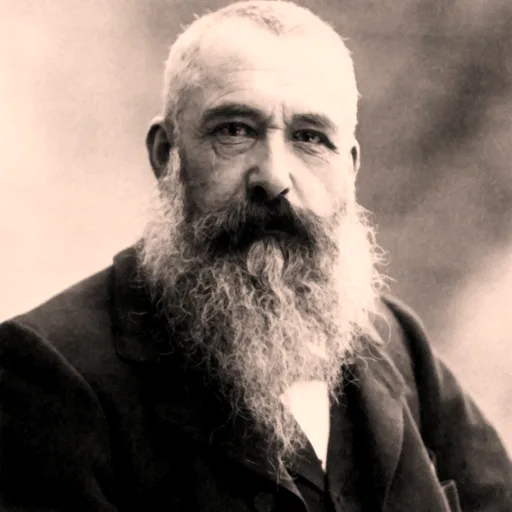
Claude Monet
France 1840-11-14 ~ 1926-12-05
French painter born in Paris in 1840, founder of Impressionism
Pursued the effects of light through color division, plein-air practice, and the series method
His late Water Lilies dissolved perspective into pure color, foreshadowing abstract art
Born in Paris in 1840, Monet founded Impressionism and gave it its name. He pursued the effects of light and atmosphere for a lifetime, culminating in Giverny's Water Lilies.
What You Can Learn
Monet's art offers modern parallels. His series method, revisiting one subject under changed conditions, mirrors the hypothesis-testing cycle of agile development. His construction of the Giverny garden to serve as motif shows deliberate environment design for creative output, a concept relevant to modern workspace planning. And his call to see light before recognizing objects echoes design thinking's principle of dropping assumptions to observe freshly.
Words That Resonate
Color is my daily obsession, my joy and my torment.
La couleur est mon obsession quotidienne, ma joie et mon tourment.
I would like to paint the way a bird sings.
Je voudrais peindre comme l'oiseau chante.
I wish I had been born blind and then recovered my sight, so I could paint without knowing what the objects before me were.
J'aurais voulu naître aveugle et avoir ensuite recouvré la vue, afin de pouvoir commencer à peindre sans savoir ce que représentent les objets que j'aperçois devant moi.
Life & Legacy
Claude Monet matters decisively because he pursued instantaneous changes of light and atmosphere more thoroughly than any other painter, effectively creating Impressionism, the largest movement in modern Western art. For him landscape was not a fixed object but a stream of perception shaped by shifting light, and capturing one cross-section of that stream was what painting was for.
Born November 14, 1840, in Paris, he grew up in Le Havre on the Normandy coast. The ever-changing light of the Seine estuary shaped his color sense. As a teenager he met plein-air painter Eugene Boudin, whose encouragement to paint outdoors became Monet's lifelong method.
In 1862 he entered Gleyre's studio in Paris and met Renoir, Sisley, and Bazille. Shared frustration with the Salon led to the first independent exhibition in 1874. Monet's Impression, Sunrise, a hazy harbor scene in quick strokes, was mocked by a critic as mere impression, accidentally naming the movement.
His key innovation was color division: placing short strokes of pure color side by side so they mix in the viewer's eye, a practice grounded in the physics of light. He banished black from shadows, using complementary colors instead, a decisive step toward the autonomy of color in painting.
From the 1890s his series method became his signature. Haystacks, Rouen Cathedral, and Waterloo Bridge each repeat a single motif under varying time, season, and weather, making the subject not the object but the light envelope around it. This approach treats perception as process, a proto-phenomenological inquiry into seeing.
In 1883 he settled at Giverny and devoted himself to designing a garden with a Japanese bridge over a lily pond. The Water Lilies series, more than 250 paintings over twenty-five years, progressively dissolved perspective; water, reflections, and flowers merge into a color field. He died December 5, 1926, at eighty-six.
Expert Perspective
Monet is the founder and spiritual pillar of Impressionism, the painter who most purely practiced color division and plein-air painting. His series method thematized the process of perception itself. The late Water Lilies, where perspective dissolves and color becomes autonomous, are precursors to Abstract Expressionism and Color Field painting. Unlike Renoir's focus on the figure or Cezanne's structural inquiry, Monet devoted his career to atmospheric phenomena.