Artists / Architecture
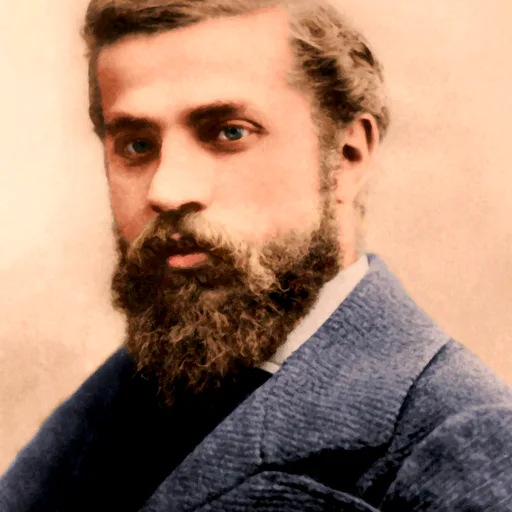
Antoni Gaudí
Spain 1852-06-25 ~ 1926-06-10
Catalan architect born in Reus in 1852
Created a unique organic architectural language in Park Guell, Casa Batllo, and the Sagrada Familia
His derivation of structure from natural geometry anticipates biomimetic design and remains a model for purpose-driven creation
Born in Reus in 1852, Gaudi created an organic architecture drawn from nature. The Sagrada Familia stands as his ultimate fusion of structure, nature, and faith.
What You Can Learn
Gaudi offers rich lessons. His derivation of form from natural geometry is an early case of biomimicry, a philosophy gaining traction in sustainable design. The Sagrada Familia, still under construction a century on, shows that a compelling vision attracts resources across generations. And his integration of art, structure, and spirituality models the purpose-driven design that resonates with contemporary audiences.
Words That Resonate
Nothing is art if it does not come from nature.
La originalidad consiste en volver al origen.
The straight line belongs to men, the curved one to God.
Nada es invención, porque todo está escrito en la naturaleza.
Originality consists in returning to the origin.
La recta es la línea del hombre; la curva es la línea de Dios.
Color in certain places has the great value of making the outlines and structural planes seem more energetic.
Mi cliente no tiene prisa.
Life & Legacy
Antoni Gaudi holds a singular position in architecture because he invented a structural language derived not from classical precedent but from the forms of nature: trees, bones, waves, and honeycombs. His buildings in Barcelona are among the most visited in the world, and the Sagrada Familia has become a symbol of the city itself.
Born June 25, 1852, in Reus, Catalonia, to a coppersmith, he studied architecture in Barcelona. Early works drew on Moorish, Gothic, and Art Nouveau sources, but he progressively developed a personal vocabulary rooted in the geometry of natural forms. His study of ruled surfaces, hyperbolic paraboloids and hyperboloids, allowed him to create complex organic shapes using structurally efficient means.
Park Guell, commissioned by industrialist Eusebi Guell, transforms a hillside into a mosaic-clad public space where columns branch like trees and benches undulate like serpents. Casa Batllo's facade ripples like water, its roof arched like a dragon's back. Casa Mila (La Pedrera) eliminates straight lines entirely, its stone facade flowing like a cliff face carved by wind.
The Sagrada Familia, begun in 1882, consumed the last four decades of his life and remains unfinished. Its design integrates Gothic verticality with organic branching columns that distribute loads like tree trunks. Gaudi envisioned the completed basilica as a Bible in stone, each facade narrating a chapter of Christ's life.
In his later years he lived as an ascetic, devoting himself entirely to the Sagrada Familia. On June 7, 1926, he was struck by a tram and, mistaken for a beggar, was taken to a charity hospital, where he died three days later at seventy-three.
Seven of his works are UNESCO World Heritage Sites. His fusion of engineering, biology, and spirituality has influenced biomimetic design, parametric architecture, and sustainable building practice.
Expert Perspective
Gaudi invented an architectural language drawn from natural forms rather than classical precedent. His use of ruled surfaces and organic geometry produced structurally efficient buildings of extraordinary beauty. The Sagrada Familia integrates Gothic scale with biological structure. Seven of his works are UNESCO World Heritage Sites, and his influence extends to biomimetic and parametric architecture.