Entrepreneurs / Entertainment
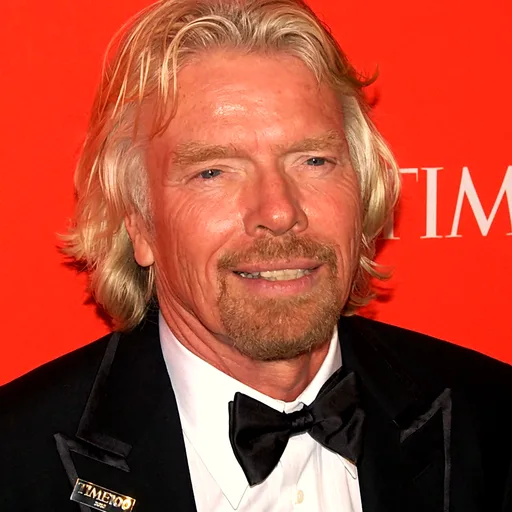
Richard Branson
United Kingdom 1950-07-18
20th-century British serial entrepreneur and adventurer
Built Virgin Group with more than 400 companies under one brand
Using a brand as a platform for lateral expansion unlocks the constraints of any single business domain
Born in 1950 in England, Richard Branson launched a student magazine at 16 and has never stopped starting businesses. From a mail-order record company he built the Virgin Group, an empire of more than 400 companies spanning music, airlines, railways, and space travel. Dyslexic yet driven by an unconventional spirit of adventure and instinct for branding, he has challenged incumbents across industries. He was knighted in 2000.
What You Can Learn
The single biggest lesson today's entrepreneurs can draw from Branson is the idea of 'using a brand as a platform.' Extending the trust and brand equity earned in one domain into entirely different industries mirrors the contemporary trend of D2C brands expanding into broader lifestyle categories. Redefining a company's core strength as 'the relationship of trust with customers' rather than 'the product' frees the business from domain constraints. His conversion of dyslexia into a management differentiator is equally instructive: a style that prioritizes face-to-face dialogue and intuition serves as a counterweight to the data-heavy bias of modern management. Centering decisions on customer emotion and employee morale can be a potent differentiator for smaller companies competing against large incumbents. And his 'turning adventure into advertising' inversion is a reference point for any company with a limited marketing budget. The founder becoming the protagonist of the brand story and earning media coverage is the prototype of the earned-media strategy in the social-media age.
Words That Resonate
Train people well enough so they can leave, treat them well enough so they don't want to.
If somebody offers you an amazing opportunity but you are not sure you can do it, say yes -- then learn how to do it later!
My biggest motivation? Just to keep challenging myself.
Business opportunities are like buses, there's always another one coming.
Screw it, let's do it.
You don't learn to walk by following rules. You learn by doing, and by falling over.
Life & Legacy
Richard Branson is the rare entrepreneur who refuses to stay in a single lane. From music to airlines to telecommunications to space, he has traversed radically different industries under one brand — Virgin — creating a business model that defies conventional diversification theory. His approach, which treats the brand itself as the platform for venture creation, carries a prescience that resonates with 21st-century platform thinking.
Born in July 1950 in Surrey, England, to a barrister father and a former flight attendant mother, Branson struggled with dyslexia from an early age, putting him at a significant academic disadvantage. His mother Eve's philosophy — 'focus on what you can do, not what you can't' — became the bedrock of his management style. He dropped out of his public school at 15 and in 1966, against the backdrop of anti-Vietnam War activism, launched Student magazine. Though modest commercially, the publication attracted attention with interviews of Mick Jagger and John Lennon.
The business turning point came in 1970 with a mail-order record venture. A postal strike caused unexpected difficulties, but the experience instilled in Branson the habit of treating the unpredictable as opportunity. In 1972 he leased a country manor in Oxfordshire, opened it as a recording studio called The Manor, and released Mike Oldfield's Tubular Bells, which sold over five million copies and propelled Virgin Records into major-label status. Signing the Sex Pistols, Culture Club, and other era-defining artists cemented his position in the music industry.
Branson's hallmark, however, is the serial-entrepreneur model of selling a successful business to fund the next challenge. In 1992 he sold Virgin Records to EMI for roughly one billion dollars and invested the proceeds in Virgin Atlantic Airways, which he had founded in 1984. Competing against British Airways — a massive incumbent — by differentiating on customer experience, including offering economy-class passengers access to a lounge, he introduced a new axis of competition to the airline industry before the rise of low-cost carriers.
The key to understanding Branson's management is what might be called 'brand venture capital.' He launches joint ventures under the Virgin name with partners in each sector, contributing brand rights and operational know-how in exchange for equity stakes. This model allows simultaneous expansion into multiple businesses without committing massive equity capital. Virgin Mobile, Virgin Active, and Virgin Galactic all follow this template.
His adventuring is inseparable from brand building. His 1986 Atlantic-crossing speed record, his 1987 transatlantic hot-air balloon flight, and similar life-risking exploits generated worldwide media coverage worth an estimated hundreds of millions of dollars in advertising equivalency. This 'founder as advertisement' strategy is the prototype of CEO personal branding in the social-media era.
Virgin Galactic, founded in 2004, aims to create a market for commercial space travel. Despite development delays and a fatal test-flight accident in 2014, Branson himself flew to the edge of space in July 2021. Forbes estimated his wealth at roughly three billion dollars as of 2023. Having turned dyslexia into a management advantage — building a style that favors dialogue over documentation — Branson's career demonstrates that entrepreneurship is not about credentials or convention but about continuous action and adaptation.
Expert Perspective
Among entrepreneurial archetypes, Branson is the definitive serial entrepreneur. He stands at the opposite pole from focused single-business builders: he established the model of leveraging brand — an intangible asset — as the lever for entry into one new industry after another. His weapons are customer experience and personality rather than technology, distinguishing him from Silicon Valley's technology-driven entrepreneurship. His adventurous management style is high-risk, but it has repeatedly punched holes in the oligopolistic structures of established industries, earning him a role as a disruptive entrant.