Scientists / Physics
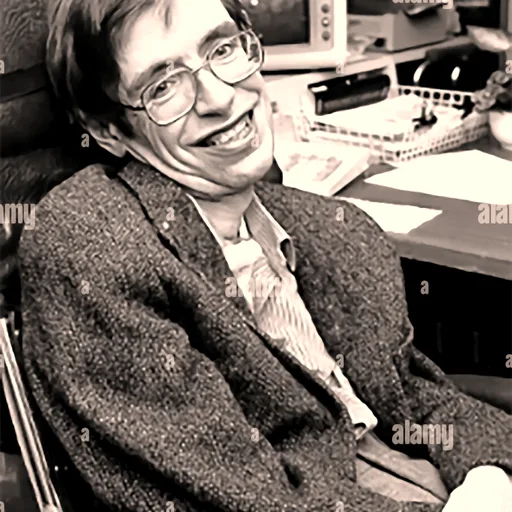
Stephen Hawking
United Kingdom 1942-01-08 ~ 2018-03-14
British theoretical physicist of the late twentieth and early twenty-first centuries
Advanced cosmology through the singularity theorems and Hawking radiation
Transcended ALS to become a global symbol of scientific intellect and resilience
British physicist born in 1942 who advanced cosmology through the singularity theorems and Hawking radiation despite living with ALS. A Brief History of Time brought cosmology to millions.
What You Can Learn
Hawking's career shows that constraints can sharpen creativity: his physical limitations drove novel thinking methods. For startups under tight resources the parallel is clear. His success as a communicator demonstrates the value of making expertise accessible. And his half-century of productivity after a terminal diagnosis exemplifies resilience in pursuing long-term goals under severe adversity.
Words That Resonate
Life & Legacy
Stephen Hawking was a leading cosmologist and one of the most effective science communicators of the modern era. Diagnosed with motor neuron disease (ALS) at twenty-one and given only a few years to live, he went on to produce groundbreaking theoretical work for over half a century.
Born on 8 January 1942 in Oxford, exactly three hundred years after Galileo's death, he studied physics at Oxford and moved to Cambridge for graduate work under Dennis Sciama. His ALS diagnosis initially crushed his motivation, but the slower-than-expected progression of the disease fueled an urgency to achieve as much as possible in whatever time remained.
In 1965 he extended Roger Penrose's singularity theorem from black holes to the universe at large, showing that general relativity implies an unavoidable singularity at the beginning of time. The Hawking-Penrose theorem gave the Big Bang theory a rigorous mathematical footing.
His most original contribution came in 1974: Hawking radiation. By applying quantum effects near a black hole's event horizon, he showed that black holes are not perfectly black but emit faint thermal radiation and eventually evaporate. The prediction bridged general relativity and quantum mechanics and raised the black-hole information paradox, one of physics' deepest open questions.
Physical constraints forced Hawking to develop a distinctive thinking style, manipulating geometric shapes mentally rather than on paper. This may have sharpened his ability to grasp problems at an intuitive level.
A Brief History of Time (1988) spent 237 weeks on the Sunday Times bestseller list and sold an estimated ten million copies, making modern cosmology part of popular culture. He died in Cambridge on 14 March 2018; his ashes were interred in Westminster Abbey near Newton and Darwin.
Expert Perspective
Among scientists, Hawking stood at the frontier where general relativity meets quantum mechanics. Hawking radiation remains a critical stepping stone toward a unified theory of quantum gravity. The Hawking-Penrose singularity theorems strengthened the mathematical foundations of Big Bang cosmology. His popular writing also made him one of science's most influential public figures, a legacy that complements his theoretical contributions.