Investors / Activist
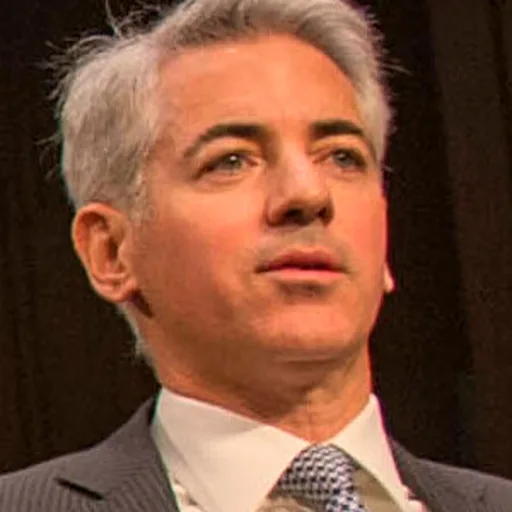
Bill Ackman
United States 1966-05-11
21st-century American activist investor
Founded Pershing Square and gained fame for pushing corporate turnarounds
Companies with clear management-change catalysts deserve a closer look
Born in 1966 in New York, Bill Ackman founded Pershing Square Capital Management and became one of the most prominent activist investors of his generation. From the boardroom battle at Canadian Pacific Railway to the billion-dollar short of Herbalife, his bold, high-conviction bets consistently attract both admiration and controversy.
What You Can Learn
Ackman's career offers lessons on both sides of the ledger. First, the concept of 'active value realization': individual investors cannot run activist campaigns, but they can look for companies where a clear catalyst — a management change, a planned restructuring — is not yet priced in. Stocks with identifiable catalysts simplify the investment thesis and reduce the need for guesswork. Second, 'resilience after failure': Ackman suffered enormous losses on Herbalife and Valeant yet came back with the COVID-hedge trade. For individual investors, the imperative is not to abandon investing after a setback but to analyze the cause and apply the lesson next time. Third, an appreciation for the risk and reward of concentrated portfolios: Ackman's biggest gains and biggest losses alike stem from a small number of high-conviction positions. Understanding the trade-off between concentration and diversification — and sizing positions accordingly — is directly relevant to anyone building a portfolio of individual stocks.
Words That Resonate
Life & Legacy
Bill Ackman is one of the most visible practitioners of activist investing — a style in which large equity stakes are used to press publicly for operational improvements, strategic shifts, or leadership changes at target companies. His approach has generated both spectacular wins and dramatic losses, keeping him perpetually at the center of Wall Street debate.
Born in 1966 in New York City, Ackman is the son of a real-estate-finance executive. He earned a bachelor's degree from Harvard and an MBA from Harvard Business School. In 1992 he co-founded Gotham Partners with a classmate, focusing on real-estate-related investments. The venture ended badly: a failed investment in First Union Real Estate Investments effectively shut the fund down in 2002.
Ackman rebounded in 2004 by launching Pershing Square Capital Management. An early win came with Wendy's: he pushed for the spinoff of Tim Hortons, which was executed and generated strong returns. That success cemented his reputation as an activist investor.
The core of Ackman's method is identifying a gap between a company's intrinsic value and its market price and then closing that gap through direct action — not by waiting passively, but by nominating directors, demanding management changes, or proposing asset sales. His investment in Canadian Pacific Railway is widely cited as a textbook activist success: he engineered a leadership overhaul, brought in Hunter Harrison as CEO, and presided over a dramatic improvement in the railroad's operational efficiency.
Ackman's career also includes high-profile failures. His roughly one-billion-dollar short of Herbalife, launched in 2012 on the thesis that the company operated a pyramid scheme, became a public spectacle when Carl Icahn took the opposite side. After about five years Ackman closed the position at a loss. His investment in Valeant Pharmaceuticals from 2015 to 2017 fared even worse: as public criticism of the company's drug-pricing strategy mounted, the stock collapsed, reportedly costing Pershing Square some four billion dollars.
What distinguishes Ackman, however, is his resilience. In March 2020, just before the COVID-induced market crash, he built a large hedging position through credit default swaps, reportedly turning roughly 27 million dollars into about 2.6 billion. The trade combined macro-risk insight with the willingness to bet big when conviction is high — signature Ackman traits.
As of 2024, Pershing Square manages roughly ten billion dollars in assets and remains one of the most influential activist funds. Ackman has signed the Giving Pledge, committing to donate more than half his wealth. He has been a vocal participant in political and social debates, including on campus antisemitism. The audacity that defines his investing extends to his public persona as well.
Expert Perspective
Among investor archetypes, Ackman represents the modern activist camp alongside Carl Icahn and Nelson Peltz. What sets him apart is his use of value-investing analytical frameworks to select targets and his habit of personally designing and executing turnaround scenarios. He sits at the opposite pole from passive long-term holders like Buffett: rather than letting compounding do the work, he intervenes directly in corporate governance to unlock value. His career profile is characterized by high amplitude — dramatic wins and dramatic losses — rather than consistency, making him an investor defined more by individual-deal explosiveness than by steady compounding.