Scientists / Physics
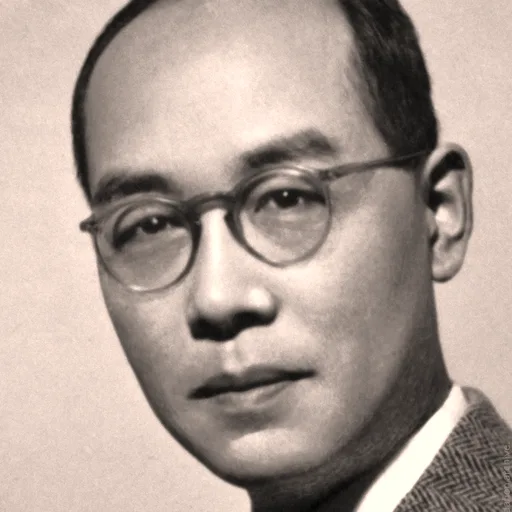
Hideki Yukawa
Japan 1907-01-23 ~ 1981-09-08
Twentieth-century Japanese theoretical physicist
Predicted the meson and became Japan's first Nobel laureate in Physics
Inspired a generation of Japanese scientists and advocated for peace and nuclear disarmament
Japanese theoretical physicist born in 1907 in Kyoto who predicted the existence of the meson in 1935. He became the first Japanese Nobel laureate in Physics (1949), inspiring a generation of Japanese scientists.
What You Can Learn
Yukawa's meson prediction shows the power of theoretical reasoning to guide experimental discovery, a model for hypothesis-driven research in any field. His postwar peace advocacy demonstrates that scientific authority carries social responsibility. And his Nobel Prize's impact on Japanese national confidence illustrates how individual achievement can catalyze institutional and cultural change. His research institute at Kyoto University became a training ground for future Nobel laureates, showing that one person's institutional investment can yield generational returns.
Words That Resonate
Truth is always found among the minority.
真実は、いつも少数派の中にある。
I want each day of life to be a step forward.
一日生きることは、一歩進むことでありたい。
To know the joy of fish -- to empathize deeply with one's subject of study.
知魚楽(魚の楽しみを知る)
Life & Legacy
Hideki Yukawa predicted the particle that mediates the strong nuclear force, a theoretical breakthrough that earned him the 1949 Nobel Prize in Physics and made him the first Japanese laureate in any scientific category.
Born in 1907 in Tokyo and raised in Kyoto, he studied physics at Kyoto Imperial University and was influenced by the Copenhagen school through his teachers. In 1935, at age twenty-eight, he proposed that the force binding protons and neutrons in the atomic nucleus is carried by a then-unknown particle with a mass intermediate between the electron and the proton. He called it the meson.
The prediction was confirmed in 1947 when Cecil Powell discovered the pi-meson (pion) in cosmic rays, matching Yukawa's theoretical specifications. The Nobel Committee awarded Yukawa the prize in 1949.
Yukawa's approach was characteristic of theoretical physics at its best: he identified a gap in existing theory, proposed a testable prediction, and waited for experimentalists to confirm it. The meson theory also opened the broader field of particle physics and contributed to the understanding of nuclear forces.
After the war he became an advocate for peace and nuclear disarmament, co-signing the Russell-Einstein Manifesto in 1955. He founded the Research Institute for Fundamental Physics at Kyoto University, nurturing the next generation of Japanese physicists.
His Nobel Prize had enormous symbolic significance in postwar Japan, demonstrating that the country could contribute to the highest levels of global science. He died in 1981.
Expert Perspective
Among scientists, Yukawa bridged the Copenhagen school and Japanese theoretical physics. His meson theory was a landmark in particle physics, opening the study of nuclear forces mediated by exchange particles. As the first Japanese Nobel laureate, he established Japan as a contributor to frontier physics and inspired successors like Tomonaga.