Scientists / Physics
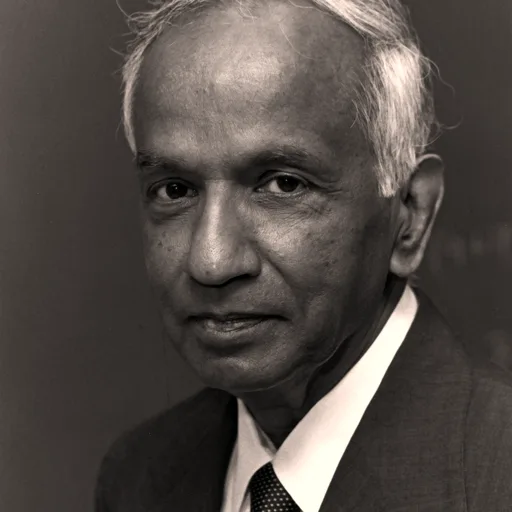
Subrahmanyan Chandrasekhar
India 1910-10-19 ~ 1995-08-21
Twentieth-century Indian-American astrophysicist
Established the Chandrasekhar limit for white dwarf stars, reshaping stellar evolution theory
Won the 1983 Nobel Prize and persevered despite early rejection by leading authorities
Indian-American astrophysicist born in 1910 who established the Chandrasekhar limit for white dwarf stars. Won the 1983 Nobel Prize in Physics for his theoretical work on stellar structure and evolution.
What You Can Learn
Chandrasekhar's persistence despite Eddington's public rejection teaches that established authority can be wrong, and that data should override prestige. His method of mastering one field completely before moving on models deep expertise development. And the Chandrasekhar limit itself reminds us that systems have critical thresholds, a concept applicable to risk management and stress testing. His systematic, field-by-field mastery demonstrates the value of deep expertise: becoming the definitive authority in one area before expanding to the next builds compounding credibility.
Words That Resonate
Life & Legacy
Subrahmanyan Chandrasekhar determined the maximum mass a white dwarf star can sustain before collapsing, a threshold now called the Chandrasekhar limit. This insight reshaped the understanding of stellar evolution and the formation of neutron stars and black holes.
Born in 1910 in Lahore (then British India), he was the nephew of physicist C. V. Raman. He studied at the Presidency College in Madras and, during the sea voyage to Cambridge for graduate study, calculated that white dwarfs above about 1.4 solar masses cannot support themselves against gravitational collapse.
At Cambridge he presented his findings, but Arthur Eddington publicly and harshly rejected them. The dispute delayed acceptance of the limit for years, but subsequent research confirmed Chandrasekhar's calculation.
He moved to the University of Chicago in 1937, where he spent the rest of his career. His research encompassed radiative transfer, stellar dynamics, hydrodynamic stability, and the mathematical theory of black holes. Each topic he mastered thoroughly before moving on, producing a definitive monograph and then starting fresh in a new area.
He won the 1983 Nobel Prize in Physics for his theoretical studies of the physical processes important to the structure and evolution of stars. NASA named the Chandra X-ray Observatory in his honor.
Chandrasekhar's career illustrates the importance of perseverance in the face of authoritative opposition. He died in 1995 in Chicago.
Chandrasekhar's approach to research was distinctive: he would immerse himself in a new field for a decade, produce a definitive monograph, then move on entirely. This pattern yielded landmark books on stellar structure, radiative transfer, hydrodynamic stability, and the mathematical theory of black holes. Each work became the standard reference in its domain, a testament to his depth and rigor.
Expert Perspective
Among scientists, Chandrasekhar is the astrophysicist who established the mass limit for white dwarfs, a result that opened the theory of stellar endpoints including neutron stars and black holes. His systematic, field-by-field approach to research produced definitive works across multiple areas of theoretical astrophysics.