Philosophers / Ancient Greek
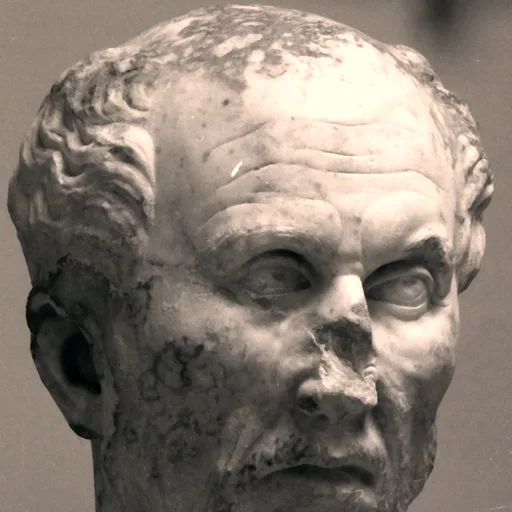
Plotinus
Italy 0205-01-01 ~ 0270-01-01
3rd-century Neoplatonic philosopher of the Roman Empire
Built a grand metaphysical system of emanation from 'the One'
'Strip away everything' is the philosophical prototype of essentialism
Born around 205 CE in Roman Egypt, Plotinus developed Plato's thought into a grand metaphysical system in which all reality emanates in stages from a supreme principle he called 'the One.' His major work, the Enneads, compiled by his pupil Porphyry, profoundly influenced Augustine, Islamic philosophy, and the intellectual tradition known as Neoplatonism.
What You Can Learn
Plotinus's thought carries surprisingly practical implications for a world saturated with information and fragmented attention. His injunction to 'strip away everything' is a method for reaching the essential by discarding the superfluous — the philosophical prototype of essentialism and minimalism in business thinking. In an environment of growing complexity, the ability to decide what not to do matters more than ever, and Plotinus's via negativa provides its foundational logic. His hierarchical emanation — from the One through Intellect to Soul to matter — also functions as a metaphor for how an organization's core vision propagates through layers of management to the front line: what is preserved and what degrades along the way is a live question for any enterprise. Furthermore, the practice of the soul's ascent — withdrawing from daily noise to engage in inner contemplation — can be reinterpreted as the wellspring of mindfulness and meditation. The idea that each person carries something divine within is a basis for self-worth independent of external success metrics.
Words That Resonate
Strive to return the divine in yourself to the divine in all.
πειρῶ ἀνάγειν τὸ θεῖον τὸ ἐν σοὶ πρὸς τὸ θεῖον τὸ ἐν τῷ παντί
Evil, too, has its place within the scheme of the Good.
ἔστιν οὖν καὶ αὐτὸ ἐν ἀγαθοῦ μέρει τὸ κακόν
It is not I who conform to the stars; the stars conform to me.
Οὐκ ἐγὼ πρὸς αὐτά, ἀλλ' αὐτὰ πρὸς ἐμέ
Let us flee then to the beloved Fatherland.
Let us flee then to the beloved Fatherland
Strip away everything.
ἀφελε πάντα
Life & Legacy
Plotinus occupies a pivotal position in Western philosophy, bridging the gap between Plato and Augustine. The emanation theory he constructed, with 'the One' at its apex, reorganized the intellectual world of late antiquity and supplied Christianity, Islam, and Judaism alike with indispensable philosophical vocabulary and conceptual frameworks.
Born around 205 CE in Lycopolis in Roman Egypt, most of what we know about his life comes from the biography written by his pupil Porphyry. At 28 he arrived in Alexandria in search of a philosophy teacher and was deeply moved by his encounter with Ammonius Saccas, under whom he studied for eleven years. Eager to learn about Persian and Indian thought, Plotinus joined the eastern campaign of Emperor Gordian III, but the emperor's death cut the expedition short and he made his way to Rome instead. This move to Rome became the true starting point of his philosophical career.
Settling in Rome past the age of 40, Plotinus opened a school and gathered students. His teaching method resembled dialogue more than lecture; he preferred to respond extemporaneously to questions from his audience. He began writing in earnest only after 50, ultimately producing 54 treatises. Porphyry reorganized these into six groups of nine — hence the title Enneads — ordered by theme rather than by date of composition. This arrangement, while not reflecting the author's own sequence, has proved invaluable for grasping the system as a whole.
The heart of Plotinus's metaphysics rests on three principles. The first, 'the One' (to hen), is the ultimate source that transcends all being and thought — an absolute unity bearing no determination whatsoever. From the One, 'Intellect' (nous) emanates, much as light radiates from the sun. Intellect corresponds to Plato's realm of Forms, a domain where being and thinking are fused. From Intellect in turn emanates 'Soul' (psyche), the mediating principle that shapes and animates the material world. Crucially, the higher principle loses nothing in generating the lower; the overflowing abundance of the One brings the world into existence without diminishing its own perfection.
Complementing this emanation theory is the practical doctrine of the soul's ascent. Individual souls that have descended into the material world can aspire to reunion with the One, passing through Intellect along the way. This ascent is simultaneously an intellectual discipline and an ethical purification — a journey from sensory desire toward inner contemplation. According to Porphyry, Plotinus experienced this mystical union four times during his lifetime. For Plotinus, however, the experience was not irrational ecstasy but the culmination of reason — an intuition at the very summit of intellect.
Plotinus's influence branched into multiple intellectual lineages from late antiquity through the Middle Ages. His pupils Porphyry and Iamblichus developed the Neoplatonic school further. Augustine drew on Plotinian emanation theory to construct the philosophical underpinnings of the Christian Trinity and the doctrine of creation. In the Arabic-speaking world, a pseudo-Aristotelian text known as the Theology of Aristotle transmitted Plotinus's ideas and decisively shaped the emanationist cosmologies of al-Farabi and Avicenna. During the Renaissance, Ficino's Latin translations sparked a fresh wave of engagement, and indirect traces can be found in German Idealism.
Plotinus reportedly felt ashamed of inhabiting a physical body and refused to sit for a portrait. The anecdote embodies his philosophy: the material form does not reflect the soul's true nature, and the real self lies beyond the world of the senses. He died around 270 CE in Campania, his health long deteriorating. Porphyry records that his final words were: 'I am striving to return the divine in me to the divine in all.'
Expert Perspective
In the history of Western philosophy, Plotinus stands as Plato's greatest heir and, at the same time, an original system-builder. In ontology he recast Plato's Theory of Forms into a dynamic emanation framework with the One as the supreme principle. In epistemology he described a graduated ascent from sensory perception through intellectual intuition to union with the One, fusing ethics and ontology into a single path. His influence on the philosophical foundations of all three Abrahamic religions — Christian theology, Islamic philosophy, and Jewish mysticism — positions him as the critical junction between ancient and medieval thought.