Philosophers / Contemporary Western
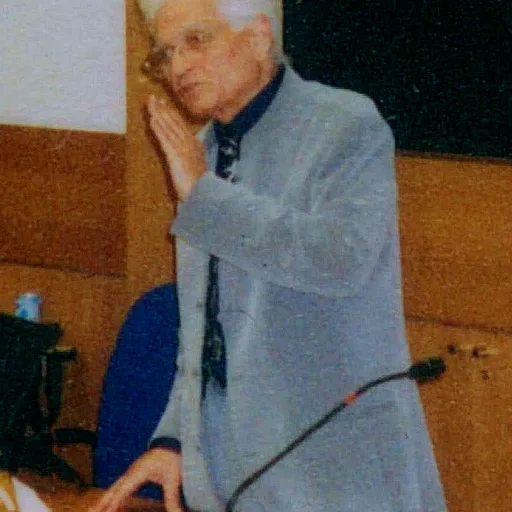
Jacques Derrida
France 1930-07-15 ~ 2004-10-08
20th-century French post-structuralist philosopher
Exposed 2,500 years of logocentrism through the method of deconstruction
Questioning binary oppositions is a practical skill for reading corporate narratives
A French philosopher of Sephardic Jewish origin, born in French Algeria. Derrida exposed the logocentrism lurking at the root of 2,500 years of Western philosophy and, through the method he called 'deconstruction,' triggered an intellectual upheaval that reached across philosophy, literary criticism, jurisprudence, and architecture. In 1967 he simultaneously published Of Grammatology, Speech and Phenomena, and Writing and Difference, becoming the central figure of post-structuralism.
What You Can Learn
Deconstruction proves its practical worth precisely in an era when information overload is the norm. In a world where social media and news outlets instantly sort everything into 'right' versus 'wrong,' 'ally' versus 'enemy,' the habit of questioning the very structure of those binaries is a foundation for critical literacy. In business, deconstruction can be applied to corporate narratives — mission statements, brand stories — asking not only what they say but what they silence. During mergers or brand integrations, surfacing the voices suppressed beneath a veneer of unity is an early-warning system for organizational risk. The proposition 'there is nothing outside the text' heightens sensitivity to the context-dependence of contracts and legal documents, sharpening legal-risk awareness. For personal development, releasing attachment to a fixed identity and treating the self as perpetually in formation is a source of resilience in an era of relentless change.
Words That Resonate
The future cannot be reappropriated.
L'avenir ne se laisse pas reapproprier.
A letter can always fail to arrive at its destination.
A letter can always not arrive at its destination.
There is nothing outside the text.
Il n'y a pas de hors-texte.
Deconstruction is justice.
La deconstruction, c'est la justice.
Every other is wholly other.
Tout autre est tout autre.
Life & Legacy
Jacques Derrida's greatest contribution to intellectual history was his demonstration that Western metaphysics rests on assumptions it has never examined — and his invention of a method for interrogating them. What he called 'deconstruction' painstakingly excavated the contradictions and suppressed layers of meaning buried within texts, destabilizing the binary oppositions that structure philosophical thought from the inside. It was not mere destruction but an exacting intellectual operation that dismantled existing frameworks while opening new possibilities of reading.
Born in 1930 in El-Biar, French Algeria, into a Sephardic Jewish family, Derrida experienced marginality from an early age. His expulsion from school under the Vichy regime's anti-Jewish statutes gave him firsthand knowledge of how arbitrarily the lines between 'inside' and 'outside,' 'orthodox' and 'deviant' can be drawn — an awareness widely regarded as the experiential root of his philosophical project. In 1949 he crossed to mainland France and entered the Ecole Normale Superieure, where he befriended Louis Althusser and Michel Foucault while immersing himself in meticulous readings of Husserl's phenomenology.
The intellectual turning point came as Derrida critically examined Husserl's theory of language and signs. Husserl had granted a privileged status to the voice — the assumption that spoken language guarantees the immediate presence of meaning. Derrida challenged this at its root. His critique expanded into an assault on the entire Western tradition of placing speech above writing. He named this bias 'logocentrism' and showed that thinkers from Plato through Saussure to Levi-Strauss shared the same presupposition.
1967 was his decisive year. Speech and Phenomena dissected Husserl's logocentrism; Of Grammatology deconstructed Rousseau and Levi-Strauss; Writing and Difference challenged the limits of structuralism from multiple angles. The simultaneous publication of all three electrified French intellectual life and positioned Derrida as the standard-bearer of post-structuralism. The concept of differance — a neologism exploiting the French words for both 'difference' and 'deferral' — became the signature key to his thought: meaning is never given as a fixed, present thing but is endlessly deferred through chains of difference.
From the 1970s onward, Derrida's influence spread rapidly beyond France. In American literary criticism, his collaboration with Yale School figures — Paul de Man, J. Hillis Miller — turned deconstructive reading into a major current. In 1986 he was appointed professor of humanities at the University of California, Irvine, and for nearly two decades maintained a transatlantic intellectual commute. In his later work, Derrida engaged directly with ethical and political themes — justice, hospitality, forgiveness, the death penalty — insisting that deconstruction is not a neutral academic technique but a response to the demand of justice. His proposition 'deconstruction is justice' opened new horizons in legal philosophy and political theory that transcend textual criticism.
Derrida died of pancreatic cancer in Paris in October 2004. Over his 74 years he produced more than forty books and hundreds of essays, sowing seeds of transformation across philosophy, literature, law, architecture, and music. The difficulty of his prose drew persistent criticism, yet the reach of the questions he opened exceeds any judgment of difficulty. He was a thinker who decisively reshaped the intellectual landscape of the late 20th century.
Expert Perspective
Within the Western philosophical tradition, Derrida critically inherited Husserl's phenomenology and Heidegger's ontology while radicalizing Nietzsche's genealogical stance at the level of language. Though commonly classified as the leading post-structuralist, he personally rejected affiliation with any school. Epistemologically, he denied the existence of a transcendental signified that would guarantee the 'presence' of meaning, instead tracing how meaning is ceaselessly generated and deferred in the movement of differance. Where his contemporary Foucault analyzed the operations of power and Deleuze explored an ontology of difference, Derrida's distinctiveness lies in his insistence on imploding the premises of metaphysics through meticulous close reading of texts.