Investors / Macro
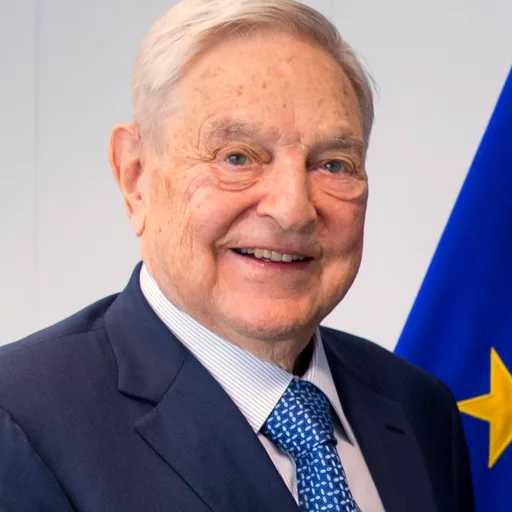
George Soros
HU 1930-08-12
20th-century Hungarian-born investor and philanthropist
Called 'the man who broke the Bank of England' for his pound short
Reflexivity theory is essential reading for an era where social media amplifies market psychology
George Soros survived Nazi-occupied Hungary, studied under Karl Popper, and built Quantum Fund into a premier hedge fund. He netted $1B shorting the pound in 1992 and has given over $32B to philanthropic causes.
What You Can Learn
Soros's reflexivity theory gains relevance as social media amplifies sentiment in real time. Three takeaways endure: size positions to conviction, not certainty; cut losses fast since the only shame lies in failing to correct errors; and watch for structural distortions in currencies, rates, and regulation. These principles help investors resist the herd behavior that social platforms intensify and build disciplined approaches to volatile markets.
Words That Resonate
It's not whether you're right or wrong that's important, but how much money you make when you're right and how much you lose when you're wrong.
I'm only rich because I know when I'm wrong.
Once we realize that imperfect understanding is the human condition, there is no shame in being wrong, only in failing to correct our mistakes.
Markets are constantly in a state of uncertainty and flux, and money is made by discounting the obvious and betting on the unexpected.
The financial markets generally are unpredictable. So that one has to have different scenarios... The idea that you can actually predict what's going to happen contradicts my way of looking at the market.
Life & Legacy
George Soros earned fame by reading markets through a philosophical lens and backing those readings with massive bets. In 1992 he shorted roughly $10 billion of pound sterling, forcing Britain out of the European Exchange Rate Mechanism on Black Wednesday and netting about $1 billion, earning the moniker 'The Man Who Broke the Bank of England.'
Born Gyorgy Schwartz in 1930 to a Jewish family in Budapest, Soros was shaped by early trauma. His father, an Esperantist and former WWI prisoner of war, taught the family survival under extreme conditions. In 1944 they assumed false identities to escape Nazi persecution, cementing his lifelong commitment to open societies.
Emigrating to Britain at 17, he studied philosophy at the LSE under Karl Popper, whose Open Society and Its Enemies became the backbone of both his investing and philanthropy. After banking stints in London and New York, he launched Double Eagle Fund in 1969, reorganized in 1970 as Quantum Fund. Starting with $12 million, it grew to $25 billion by 2011.
His core idea is reflexivity: market participants' beliefs alter fundamentals, creating feedback loops that efficient-market theory ignores. Markets are always biased; when bias accelerates, bubbles or crashes result. Identifying tipping points yields outsized returns.
Beyond finance, Soros has donated over $32 billion through the Open Society Foundations, funding democratic governance, scholarship programs, and human rights causes. He co-founded Central European University in Budapest. Calling himself a 'statesman without a state,' he treats market profits as fuel for advancing open, democratic societies.
Expert Perspective
Soros defines global macro. While Buffett works bottom-up, Soros exploits top-down distortions in currencies, rates, and policy. His Popperian grounding separates him from peers and shaped Dalio and Druckenmiller. He concentrates capital at inflection points seeking asymmetric payoffs.