Philosophers / Contemporary Western
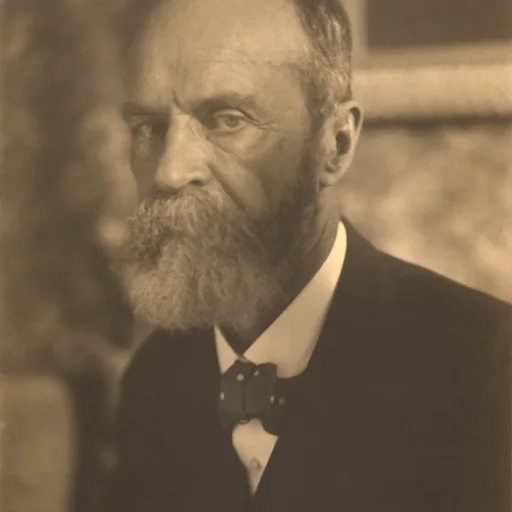
William James
United States 1842-01-11 ~ 1910-08-26
19th-century American psychologist and pragmatist philosopher
Opened America's first psychology course and coined the 'stream of consciousness'
Pragmatism's test — 'does it actually work?' — is the operating principle for the AI age
Born in New York in 1842, William James laid the intellectual foundations of both psychology and philosophy in America. He established the country's first psychology course in 1875, earning the title 'father of American psychology,' and co-founded pragmatism with Peirce. His concept of the 'stream of consciousness' influenced literature as well as science, and The Varieties of Religious Experience reframed religion as personal inner experience.
What You Can Learn
James's pragmatism evaluates ideas not by whether they are theoretically correct but by whether they actually work. In an era when AI tools and methodologies proliferate faster than anyone can evaluate them, this stance is a powerful guide: rather than waiting for the theoretically perfect solution, test, measure, and judge by concrete results. His youthful triumph over depression through the deliberate decision to change his own thinking anticipates the core mechanism of cognitive behavioral therapy — the 'cognitive restructuring' that clinicians employ today is structurally identical to the attitude shift James practiced over a century ago. The Varieties of Religious Experience, which privileged personal experience over institutional doctrine, also finds new relevance as mindfulness and meditation gain scientific validation. In organizational decision-making, James's pragmatic question — 'What concrete difference does this belief make in how we act?' — cuts through unproductive meetings and steers discussion toward actionable outcomes.
Words That Resonate
The true is the name of whatever proves itself to be good in the way of belief, and good, too, for definite, assignable reasons.
The art of being wise is the art of knowing what to overlook.
Act as if what you do makes a difference. It does.
The greatest discovery of my generation is that a human being can alter his life by altering his attitudes of mind.
Be not afraid of life. Believe that life is worth living, and your belief will help create the fact.
A great many people think they are thinking when they are merely rearranging their prejudices.
Life & Legacy
William James's place in intellectual history defies single-discipline classification. He pioneered experimental psychology as an independent science, systematized pragmatism as a new philosophical method, and extended rigorous inquiry into the domain of religious experience. That one person traversed all three fields embodies the very 'unity of experience' at the core of his thought.
Born in 1842 as the eldest son of theologian Henry James Sr., he grew up in an uncommonly cosmopolitan household. His father distrusted conventional schooling and moved the family across Europe — Paris, London, Geneva — exposing the young James to multiple languages and cultures. His brother Henry would become one of America's great novelists; William initially aspired to be a painter. Abandoning that path, he enrolled at Harvard to study medicine. During his student years he joined an Amazon expedition but was dogged by chronic ill health and severe depression. The turning point came when he encountered the French philosopher Charles Renouvier's writings on free will. The conviction that one can change one's own thinking by an act of will planted the seed of pragmatism.
In 1872 James began teaching physiology at Harvard; by 1875 he had opened the first psychology course in the United States — four years before Wilhelm Wundt established his experimental-psychology laboratory in Germany. His magnum opus, The Principles of Psychology (1890), took twelve years to write. Despite its 1,200-plus pages, the book's vivid prose and penetrating observations transformed the standard of psychology textbooks. Its most enduring contribution was the concept of the 'stream of consciousness,' which described awareness not as a static collection of elements but as a ceaselessly flowing continuum. The idea went on to shape the literary techniques of James Joyce and Virginia Woolf, catalyzing a revolution in 20th-century narrative form.
As James shifted from psychology to philosophy, he took the pragmatism concept originated by Charles Sanders Peirce and gave it a broader, more practical application. Where Peirce envisioned pragmatism as a method of logical clarification, James expanded it into a full-scale philosophy of action. For James, truth was not a matter of abstract coherence; it was verified by whether an idea actually works in lived experience. This stance — which married American practical-mindedness to philosophical rigor — inevitably attracted criticism. Bertrand Russell and others accused him of equating truth with convenience. James responded repeatedly that pragmatism was not an abandonment of truth but an experimental attitude toward it.
His Gifford Lectures at the University of Edinburgh in 1901-1902, published as The Varieties of Religious Experience, treated religion not as doctrine or institution but as raw, first-person inner experience. He analyzed conversion, mystical states, and saintliness with psychological methods while fully acknowledging the transformative power such experiences exerted on individual lives. The work anticipated concerns later taken up by transpersonal psychology.
In his final years, James developed 'radical empiricism,' which rejected the dualism of subject and object, mind and matter, positing pure experience as the starting point of all inquiry. This idea resonated with the Japanese philosopher Kitaro Nishida, whose concept of 'pure experience' drew direct inspiration from James, forming a node in the East-West philosophical dialogue. The novelist Natsume Soseki was also influenced by James's psychology, connecting his thought to the intellectual formation of modern Japan. James died in 1910 at Chocorua, New Hampshire, of heart disease, at the age of 68.
Expert Perspective
Within the lineage of Western philosophy, James transplanted British empiricism onto American intellectual soil and cultivated it into a distinctly practical philosophy. His attempt to forge a third path between Continental rationalism and British empiricism through pragmatism defined the character of American philosophy in a direction distinct from Peirce's more formal logical approach. In bridging psychology and philosophy he parallels Husserl's phenomenology, and his radical empiricism — which rejects the subject-object split — connects forward to process philosophy and the thought of Whitehead.