Scientists / Mathematics
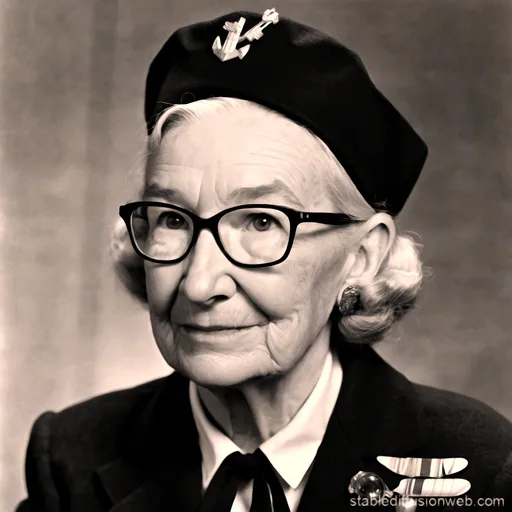
Grace Hopper
United States 1906-12-09 ~ 1992-01-01
Twentieth-century American computer scientist and US Navy rear admiral
Pioneered the compiler and helped create COBOL, democratizing computing
Championed the idea that machines should adapt to people, not the other way around
American computer scientist and US Navy rear admiral born in 1906 who pioneered the compiler and helped develop COBOL. She popularized the term 'debugging' and championed machine-independent programming languages.
What You Can Learn
Hopper's compiler concept, translating human intent into machine execution, is the conceptual ancestor of every high-level programming language and no-code tool. Her maxim about 'we've always done it this way' is a battle cry against organizational inertia. And her advocacy for machine-independent languages anticipates modern platform-agnostic and cloud-native development. Her emphasis on human-readable programming anticipated the user-experience revolution: technology succeeds when it meets people where they are, not where engineers think they should be.
Words That Resonate
Life & Legacy
Grace Hopper was a pioneer of computer programming who believed that computers should be accessible to non-mathematicians. Her development of the first compiler and her leadership in creating COBOL transformed computing from an elite specialty into a tool for business and government.
Born in 1906 in New York City, she earned a PhD in mathematics from Yale in 1934. She taught mathematics at Vassar College before joining the US Navy during World War II, where she was assigned to the Harvard Mark I computer.
At the Mark I she became one of the first programmers, writing the machine's operating manual. She popularized the term 'bug' after a moth was found in a relay of the Mark II (though the term predated her, the incident became legendary).
Her most significant contribution was the concept and development of the compiler, a program that translates human-readable code into machine instructions. Critics said it was impossible; Hopper proved them wrong. The compiler made programming accessible to people without deep hardware knowledge.
She was instrumental in developing COBOL (Common Business-Oriented Language), one of the first programming languages designed for business applications. COBOL became the dominant language for banking, government, and corporate computing for decades.
Hopper served in the Navy until retirement at age seventy-nine, reaching the rank of rear admiral. She received the Presidential Medal of Freedom posthumously in 2016. She died in 1992.
Her legacy is the democratization of computing: the idea that machines should adapt to people, not the other way around.
Expert Perspective
Among scientists, Hopper is a foundational figure in computer science and software engineering. The compiler she pioneered enabled the programming-language ecosystem that made computing universal. COBOL's longevity in business systems attests to the durability of her design philosophy. Her career also demonstrates a woman's leadership in a field that would become male-dominated.